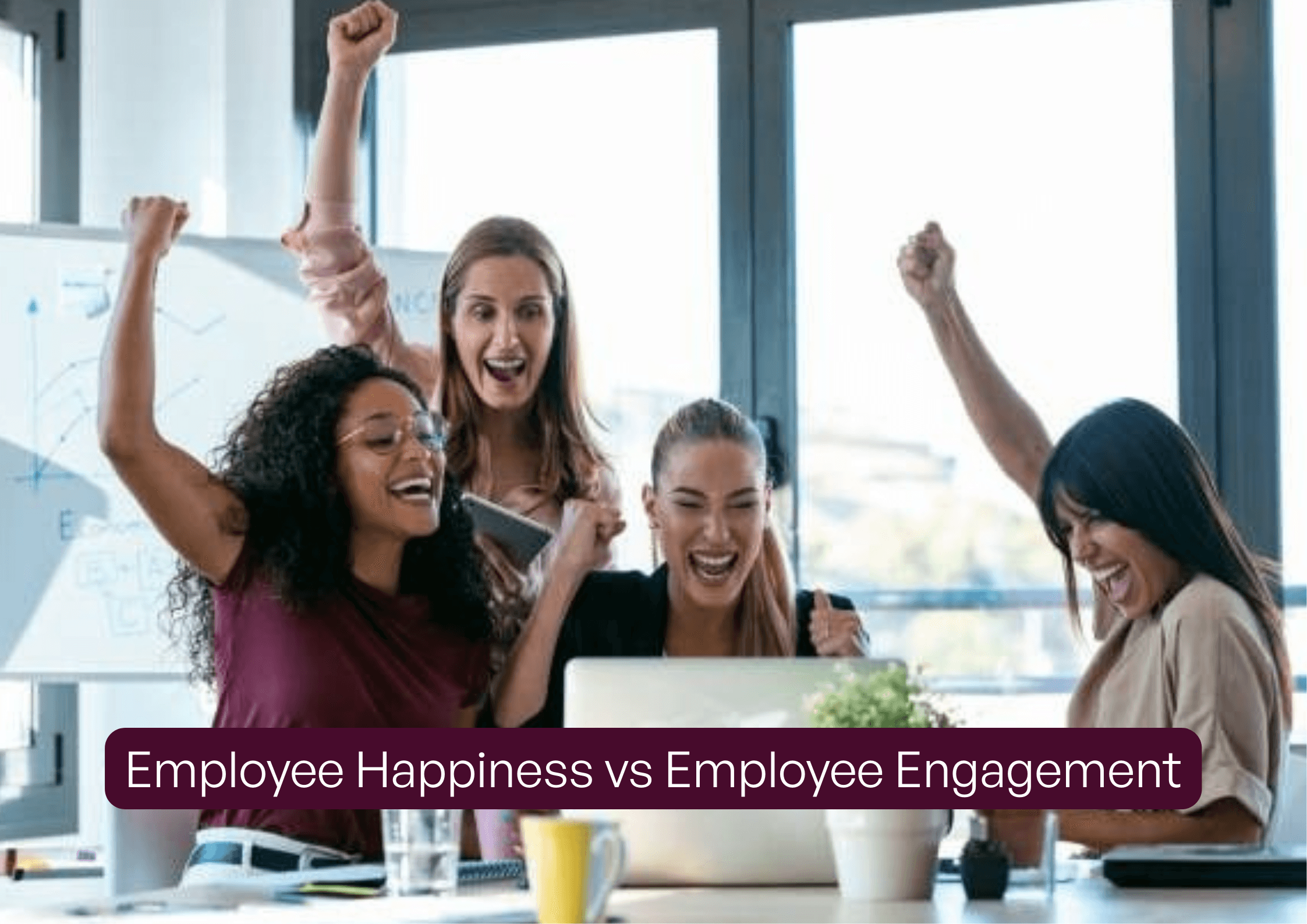
In today’s evolving workplace, organizations often use the terms employee happiness and employee engagement interchangeably. But are they really the same?
While both contribute to a positive workplace culture and improved business outcomes, employee happiness and employee engagement represent different psychological and behavioral dimensions of the workforce.
Understanding the difference between employee happiness and employee engagement is critical for HR leaders, founders, and people managers who want to build high-performing, resilient organizations.
In this guide, we break down:
- What employee happiness means
- What employee engagement means
- The key differences between the two
- Why both matter for business success
- How to measure and improve each effectively
What Is Employee Happiness?
Employee happiness refers to an individual’s emotional state at work. It is about how employees feel about their job, environment, colleagues, and leadership.
A happy employee typically:
- Feels valued and respected
- Experiences low stress
- Enjoys workplace relationships
- Feels supported by management
- Maintains work-life balance
Employee happiness is largely emotional and subjective. It focuses on overall well-being rather than productivity alone.
Key Drivers of Employee Happiness
- Positive workplace culture
- Fair compensation and benefits
- Recognition and appreciation
- Psychological safety
- Flexibility and autonomy
- Supportive leadership
Happiness is about emotional satisfaction.
What Is Employee Engagement?
Employee engagement refers to the level of commitment, involvement, and enthusiasm an employee has toward their work and organization.
An engaged employee:
- Is motivated to perform
- Feels connected to company goals
- Takes initiative
- Goes beyond minimum requirements
- Actively contributes to team success
Engagement is behavioral and performance-oriented.
It answers the question:
“How invested is this employee in the company’s success?”
Employee Happiness vs Employee Engagement: The Core Difference
Although related, these concepts are not identical.
Employee happiness and employee engagement differ in both focus and impact. Employee happiness refers to an individual’s emotional state at work — it centers on well-being and answers the question, “How do I feel?” It is largely influenced by workplace culture, environment, relationships, and overall psychological comfort. Importantly, an employee can feel happy without necessarily delivering high performance. Employee engagement, on the other hand, reflects behavioral commitment and performance alignment. It answers the question, “How invested am I?” Engagement is driven by purpose, goal alignment, ownership, and connection to organizational objectives. While happiness focuses on emotional satisfaction, engagement is usually linked to productivity, initiative, and measurable contribution to business success.
Important Insight
An employee can be:
- Happy but not highly engaged
- Engaged but not necessarily happy

Can Employee Happiness Exist without Engagement?
Yes.
For example:
An employee may:
- Enjoy coworkers
- Have a relaxed environment
- Feel comfortable
But:
- Not feel challenged
- Not feel aligned with company mission
- Not take initiative
They’re content but not deeply invested.
This often happens in low-pressure environments without clear growth paths.
Can Employees Be Engaged but Not Happy?
Yes.
An employee might:
- Be committed to company success
- Work hard
- Deliver high performance
But:
- Experience burnout
- Feel stressed
- Lack work-life balance
They are productive but not emotionally satisfied.
This scenario is common in high-growth startups or high-pressure corporate roles.
Why Both Employee Happiness and Engagement Matter
Organizations that focus only on engagement risk burnout.
Organizations that focus only on happiness risk complacency.
Sustainable performance requires balance.
Benefits of Employee Happiness
- Lower absenteeism
- Reduced workplace conflict
- Higher retention
- Improved mental health
- Better team collaboration
Benefits of Employee Engagement
- Increased productivity
- Higher innovation
- Stronger customer satisfaction
- Improved profitability
- Higher performance metrics
Research consistently shows that engaged employees contribute significantly more to business outcomes but employee happiness fuels long-term sustainability.
The Business Impact of Getting It Right
Companies that prioritize both employee happiness and engagement experience:
- Reduced turnover costs
- Stronger employer branding
- Higher team morale
- Improved financial performance
When employees feel emotionally supported and purpose-driven, they perform at their best.
Modern HR leaders must therefore measure and manage both dimensions.
How to Measure Employee Happiness
Because happiness is emotional, measurement requires thoughtful methods.
Common Ways to Measure Employee Happiness
- Pulse surveys
- Anonymous feedback forms
- Employee Net Promoter Score (eNPS)
- One-on-one conversations
- Well-being assessments
Questions often focus on:
- Job satisfaction
- Work-life balance
- Leadership trust
- Emotional well-being
Regular feedback loops help track happiness trends over time.
How to Measure Employee Engagement
Engagement measurement focuses more on motivation and commitment compared to employee happiness.
Engagement Survey Indicators
- Alignment with company mission
- Willingness to recommend employer
- Desire to grow within company
- Sense of ownership
- Level of discretionary effort
Engagement surveys often evaluate:
- Productivity mindset
- Career growth satisfaction
- Recognition and feedback
- Manager support
The key is consistency in tracking and acting on results.
How to Improve Employee Happiness
Improving employee happiness requires building a supportive culture.
Practical Strategies:
- Promote psychological safety
- Offer flexible work options
- Recognize contributions regularly
- Encourage open communication
- Support mental health initiatives
- Ensure fair compensation structures
Small cultural improvements often have large emotional impact.
How to Improve Employee Engagement
Improving engagement requires clarity and purpose.
Practical Strategies:
- Align individual goals with company vision
- Provide clear growth paths
- Offer skill development programs
- Encourage ownership and accountability
- Strengthen leadership transparency
- Provide regular performance feedback
Employees engage more when they see meaning in their work.
The Role of Hybrid Work in Happiness & Engagement
The rise of hybrid and remote work has reshaped both employee happiness and engagement.
Remote work can:
- Increase happiness through flexibility
- Reduce engagement due to isolation
To maintain balance, organizations must:
- Encourage structured communication
- Conduct regular pulse surveys
- Promote team bonding activities
- Monitor burnout indicators
Technology now plays a critical role in tracking workplace sentiment in real time.
Building a Workplace That Prioritizes Both
The future of HR is not about choosing between happiness and engagement.
It’s about designing systems that support:
- Emotional well-being
- Purpose-driven performance
Organizations that actively listen to employee feedback, analyze workplace sentiment, and act are more likely to thrive.
Modern employee happiness platforms help organizations:
- Track real-time sentiment
- Identify engagement gaps
- Monitor burnout risks
- Improve workplace culture through data-driven insights
Final Thoughts
Employee happiness and employee engagement are connected — but they are not the same.
Happiness focuses on how employees feel.
Engagement focuses on how employees perform.
To build resilient, high-performing teams, organizations must nurture both.
By measuring workplace sentiment consistently and aligning employees with purpose, companies can create a culture where people are both emotionally fulfilled and deeply committed to success.
FAQs
Is employee happiness more important than engagement?
Neither is more important. Happiness ensures emotional stability, while engagement drives performance. Both are essential.
Can employee engagement exist without happiness?
Yes, but it may lead to burnout if emotional well-being is neglected.
How often should companies measure employee happiness?
Quarterly pulse surveys are ideal, with continuous feedback mechanisms for real-time insights.