The success of research depends on the quality of data, which in turn depends on the right audiences or participants. Accordingly, the need for precise data collection has never been greater in the fast-paced market research landscape. Screener Questions emerges as a powerful tool here in the research toolkit, and this blog will dive deep into what Screener Questions are and their types and benefits.
What Are Screener Questions?
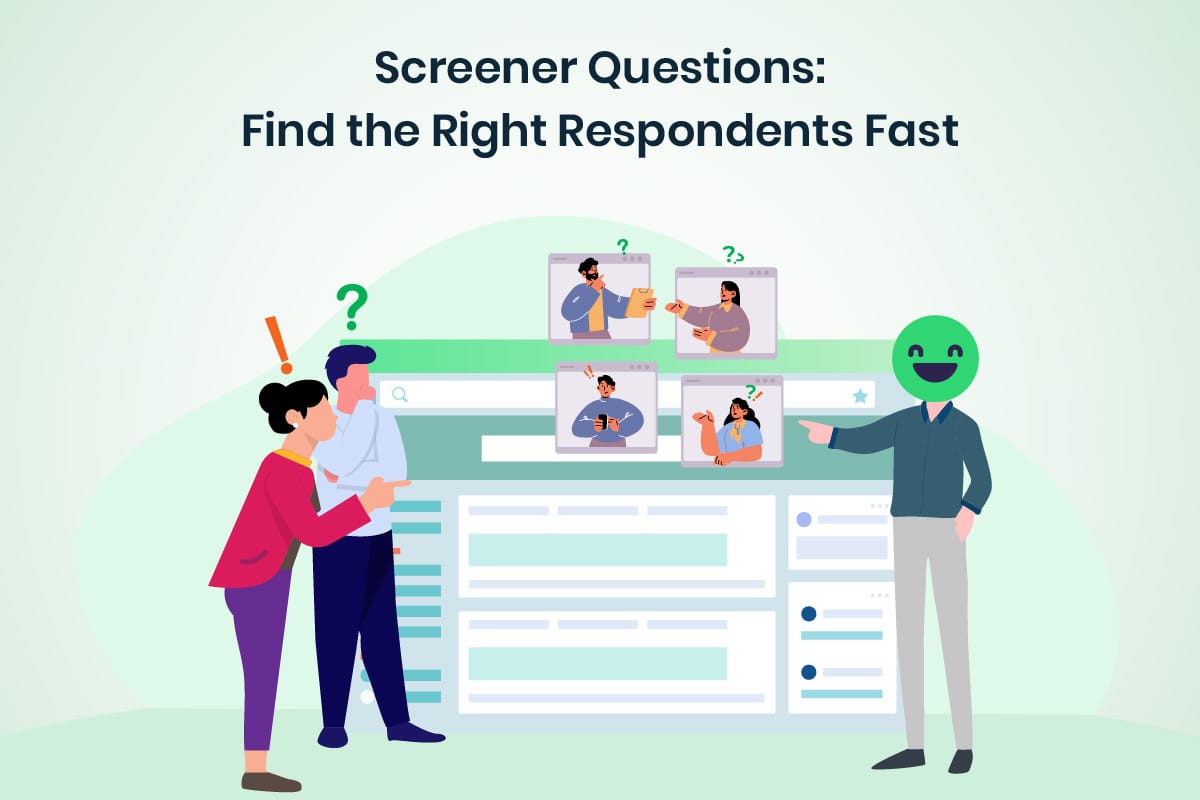
Screener questions are first gatekeepers in surveys to identify and select participants who meet specific criteria that align with a study’s objectives. The concept of What Are Screening Questions sits at the beginning of a survey and filters out participants who do not meet the target criteria.
Screener questions typically collect more information about the participants. A good survey screener will include many aspects of a potential participant’s behavior, attitude toward a product, and the frequency with which they use a given product. A well-developed screener serves as a roadmap to identify the ideal participants for a study. By conducting screening questions, this will ensure that the person will have the appropriate background to give useful feedback about a product.
The significance of Screener Questions
The purpose of screener questions is to:
- Establish Target Audience: By identifying the demographic and/or behaviors that should characterize target respondents.
- Improve Data Quality: By removing participants who do not fit the criteria, this increases the overall quality of data collected.
- Reduce Time and Resources: Enable to rapidly identify a small group of potential participants and provide incentives to those who will be asked to complete the entire survey or study.
Types of Screening Questions
Screeners can be very different from one another, and the questions that are asked should relate directly to the research objectives. Most screening questions fall into various categories with distinct objectives, and these categories are generally as follows:
1. Demographic Screening Questions
Demographic screening questions describe a potential participant’s demographic attributes (age, sex, income, location, etc.) which help inform the researcher where within their target market to place respondents. These types of screening questions serve as the foundation for the market segmentation strategy, helping to ensure that the segments identified represent the overall market and offer diversity without overcomplicating the qualification process.
2. Behavioral Questions
These questions investigate the past actions and habits of individuals to uncover past or present behavior patterns related to the product category. For instance: “On average, how many times do you use a food delivery application each month?” or “What running shoe brands were purchased within the last year?”
Behavioral data is generally a better predictor of future purchases than attitudinal data, because behavioral data shows what people do, while attitudinal data represents what people think they will do. This type of question provides insight into customer behavior that is used to develop targeted marketing strategies.
3. Attitudinal Questions
These types of screening questions might assess brand loyalty, openness to new technology, or environmental consciousness based on activities, interests, opinions, and values.
A few examples of attitudinal questions:
- Satisfaction Levels: What is your level of satisfaction in Product Y?
- Perception: What is your opinion of Product Z’s new features?
The responses collected will assist product developers and marketers in determining the directions to take with their products.
4. Industry-specific
To avoid competitors in a B2B software study, industry-specific screening questions, such as “In which sector do you work: Healthcare, Finance, or Other?” are tailored to professional contexts.
By ensuring external viewpoints that are objective and widely applicable to target markets, these types of screening questions protect against insider prejudice.
Benefits of Screener Questions
Every survey aims to collect essential information which helps organizations make better decisions. Data becomes misleading when audience validation does not occur properly. The use of Screening Questions Benefits is therefore vital in ensuring quality insights and saving both time and resources.
1. Improved Relevance and Accuracy
Screening questions provide the main advantage of getting respondents who match your target group. The questions you design should help you confirm that respondents have the required background knowledge to provide useful answers. Your content becomes more relevant to your target audience when you create content that matches their interests and needs.
2. Increased Engagement
When respondents qualify through effective screening questions, they tend to show more interest in the study. Survey and interview completion rates improve when participants show interest in the topic and possess relevant knowledge. This leads to more reliable data.
3. Cost Efficiency
Targeted research produces major financial savings for organizations. The process of finding suitable respondents helps you avoid collecting data which becomes useless. Your study will use less resources because it will not include participants who fail to meet your study requirements.
4. Increases Research Effectiveness
Lastly, by clearly expressing criteria up front, fostering trust, and easing the irritation of disqualified users who might otherwise feel misled, screening questions help advance ethical research.
Crafting Effective Screener Questions
1. Best Practices Overview
To achieve the desired impact, start by clearly defining the criteria for inclusion and exclusion before actually drafting screener questions. Limit the questions to witness high completion rate, and always pilot test with a small group to be able to make refinements.
2. Avoiding Common Pitfalls
An excessive number of screening questions is a common reason for respondents’ frustration and hence, the reduction of completion rates. Although being precise is good, if you are too restrictive, you may drastically decrease your sample size. Pilot testing is your guarantee that there will be no mistakes and that the survey flow will be smooth for the actual respondents.
3. Implementing Logic and Flow
Use skip logic to make the flow smooth, hence, qualified users are directed onward whereas those who are not offered a polite exit. Arrange questions starting from general (for example demographics) to more specific (for example behaviors) so that the progression sounds natural.
4. Ethical and Inclusive Considerations
Help inclusiveness be ensured by having “Prefer not to say” and “Other” options as these respect privacy and diversity. Keep on updating your questions so that they reflect ever-changing societal norms and thus, help you conduct fair and representative research.
5. Choose The Right Platform
It’s important to choose a tool that meets your needs, whether that’s a simple Google Form, a survey tool like piHappiness, or a more advanced market research platform. Branching logic cannot be compromised. This enables the immediate disqualification of respondents based on a prior response or the asking of follow-up questions.
Conclusion
Screener Questions represent the strategic foundation of any top-tier research. Essentially, they serve as the main boundary that prevents the occurrence of biased data and unnecessary spending of resources. With screening questions, realize their advantages, use the appropriate types, and witness improvement in research quality enormously. Begin with your upcoming survey by using focused filters and see the quality of people answering survey increase adequately.