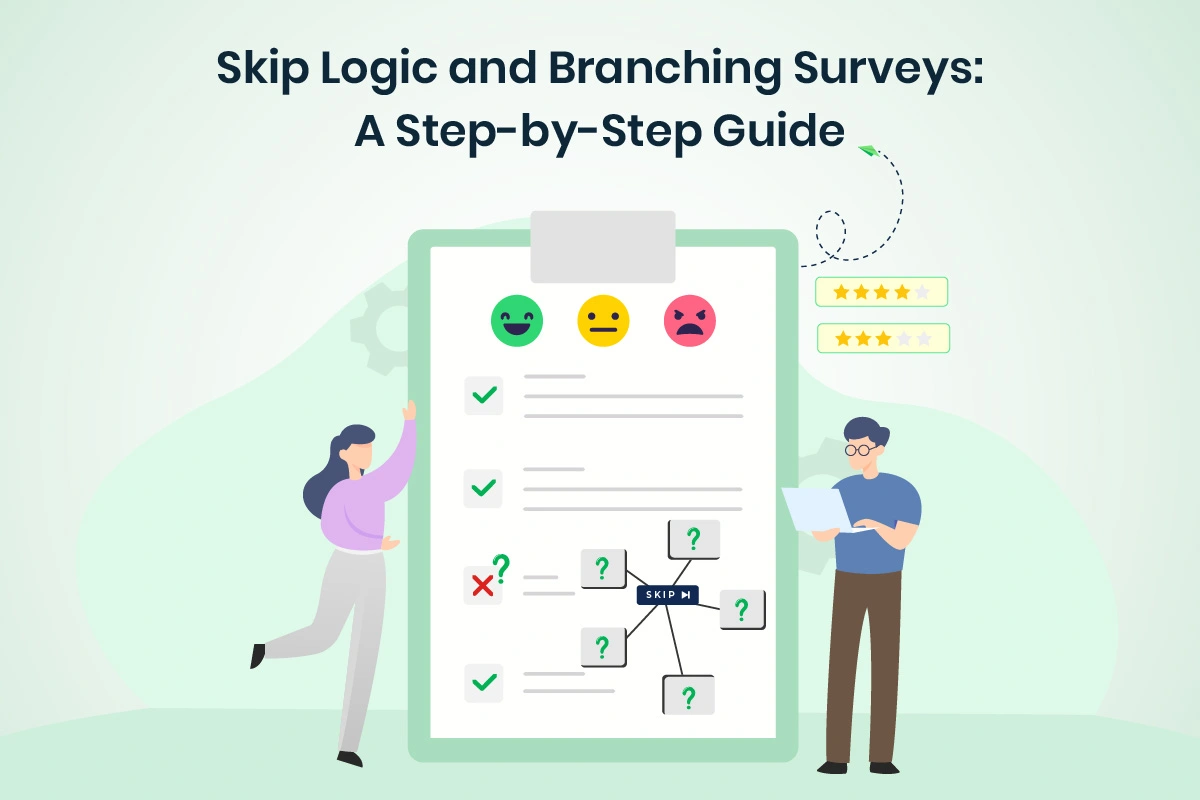
Designing surveys that are relevant and engaging has become essential. Traditional surveys just push a bunch of questions at people, many of which don’t even apply to them. This leads to people quitting, giving incomplete answers, or providing bad data. That’s why the Skip Logic Survey is so powerful. By changing the path of the survey based on each person’s past answers, skip logic builds a customized experience that boosts response quality and completion rates.
Skip logic, also known as branching guides respondents to specific questions or sections based on how they answer earlier ones. The survey system only presents questions that directly relate to each respondent’s specific situation. The result? Accurate insights gathered faster.
Understanding Skip Logic
Skip Logic Surveys apply Conditional Logic to determine the questions shown to the respondents and the ones that are not, depending on their responses to earlier questions. Skip Logic saves valuable time and insights and improves the overall interview experience for both participants and the researchers. Skip Logic Survey reduces survey fatigue among respondents, which leads to an increase in the number of respondents to their surveys.
Skip Logic surveys make it possible for the respondents to be part of an interesting process because they get questions that correspond exactly to their responses. For example, if a participant indicates that they have not used a product, they will be immediately asked about non-users of that product.
This makes the survey more effective both for the participants and researchers by giving both parties a better quality of data. This saves time for the respondent and gives researchers cleaner, more accurate data.
Types of Survey Skip Logic
There are primarily two types of Survey Skip Logic: conditional and unconditional branching. The conditional branching logic is based on the responses given by the respondents. For example, in a healthcare survey, a question can be asked whether the respondent has any chronic condition. Based on the ‘yes,’ response, it may further prompt symptom-based questions, whereas for ‘no,’ it will skip general wellness-related questions. This kind of skip logic works best when the nature of the survey requires more in-depth responses, such as in the case of market segmentation.
Unconditional branching logic is applied to all participants consistently regardless of their responses. This method is generally used for primary filter inquiries like a question about the respondent’s age.
Below are also different sub-types of skip logic:
- Question-Level Skip Logic: This type of skip logic directs respondents to a specific question based on their previous answer. It is useful for controlling the flow of a survey at a granular level.
- Page-Level Skip Logic: This type allows for skipping an entire page or section of questions, which can help streamline longer surveys and improve the user experience.
- Reverse Skip Logic: This type allows respondents to go back and answer a previous question if they feel it would beneficial. This adds a layer of flexibility to the survey.
- Multi-Question Logic: This type uses the responses from multiple questions to determine where a respondent should go next. This type can create more complex pathways through the survey.
Each type has its own advantages and disadvantages depending on the length and complexity of the survey. It’s critical to choose wisely to not fall into what’s known as a “logic trap,” where a path simply dead ends without warning or explanation.
Smart Skip Survey Questions
Skip survey questions are the hinges on which branching logic swings. These questions are typically decision-point ones like multiple-choice, dropdown, or yes/no, that cause the branching. A question such as “do you engage with our brand” is a poorly worded that can lead to uncertain paths. Every answer option has a carefully designed destination. Well-written skip survey questions serve as instinctive gatekeepers, automatically guiding respondents to survey content relevant to them.
Benefits of Using Skip Logic
- Higher Completion Rates: By asking only relevant questions, respondents won’t be driven away by frustration and drop out of the survey.
- Improved Data Quality: The responses are much more accurate, since they are focused on the respondent’s direct knowledge and experience.
- Better User Experience: An efficient survey experience results in a better participant experience which shines well on the organization administering the survey.
Step-by-Step Guide to Designing Skip Logic Surveys
The design of a branching survey requires a structured approach to ensure that it runs smoothly. Start with objective clarity: What do you want to learn from whom? Develop respondent personas to anticipate branches.
Step 1 – Create the Flowchart
Visualize the survey as a decision tree. Tools or built-in platform previews help you diagram “if-then” sequences. Start linear, then add conditions.
Step 2 – Define Trigger Questions
Identify key questions like closed-ended ones (example multiple-choice) to work best as gates. Exclude open text for triggers to keep it predictable.
Step 3 – Build and Configure Logic
Apply rules in the survey tool. For each answer, specify the destination. Test for overlaps to make sure there are no infinite loops.
Step 4 – Add Validation
Use mandatory fields wisely and add progress bars to let users know they’re moving forward.
Step 5 – Extensive Testing
Simulate different paths. Run through different personas, test on mobile. Collect feedback to refine.
Common Mistakes to Avoid
When designing a skip logic survey be sure to avoid the following mistakes:
- Complicating Logic: While trying to determine the best logic needed, it can be easy to plan the survey and make it much more complex than needed, leading the survey in circles. Keep it simple.
- Lack Of Mobile Survey Design: People complete most surveys from a mobile device, so design the survey in a way that is easy to complete on a mobile device.
- Incomplete Testing: Less testing can lead to more issues than having a completed survey, more issues with logic, taking the survey, and data reliability.
The piHappiness Advantage
Platforms such as piHappiness provide a great example of how user-friendly design tools can animate complex branching strategies. piHappiness provides powerful, visual tools for constructing advanced Skip Logic Surveys, allowing designers to effortlessly apply multiple types of survey skip Logic and fine-tune their skip survey questions. Its built-in analytics then assist in making sense of the powerful, segmented data captured, transforming smart design into actionable CX knowledge.
Conclusion
A skip logic survey is now essential for any business aspiring to take surveys that are accurate and respondent friendly. Survey creators who apply the principles of skipping efficiently, are able to remove irrelevant questions, increase engagement, and reach deeper insights more quickly.
Skip logic is critical for all types of surveys, including customer feedback surveys, product research surveys, and employee survey assessments. It enables survey creators to build their surveys to be relevant for each individual respondent. A survey design that utilizes skip logic evolved from a normal survey to a highly defined respondent-focused experience. Thus, it helps create a better-quality dataset and leads to more informed decisions.
Platforms like piHappiness will help to make the skip logic design development process as effective and seamless as possible.