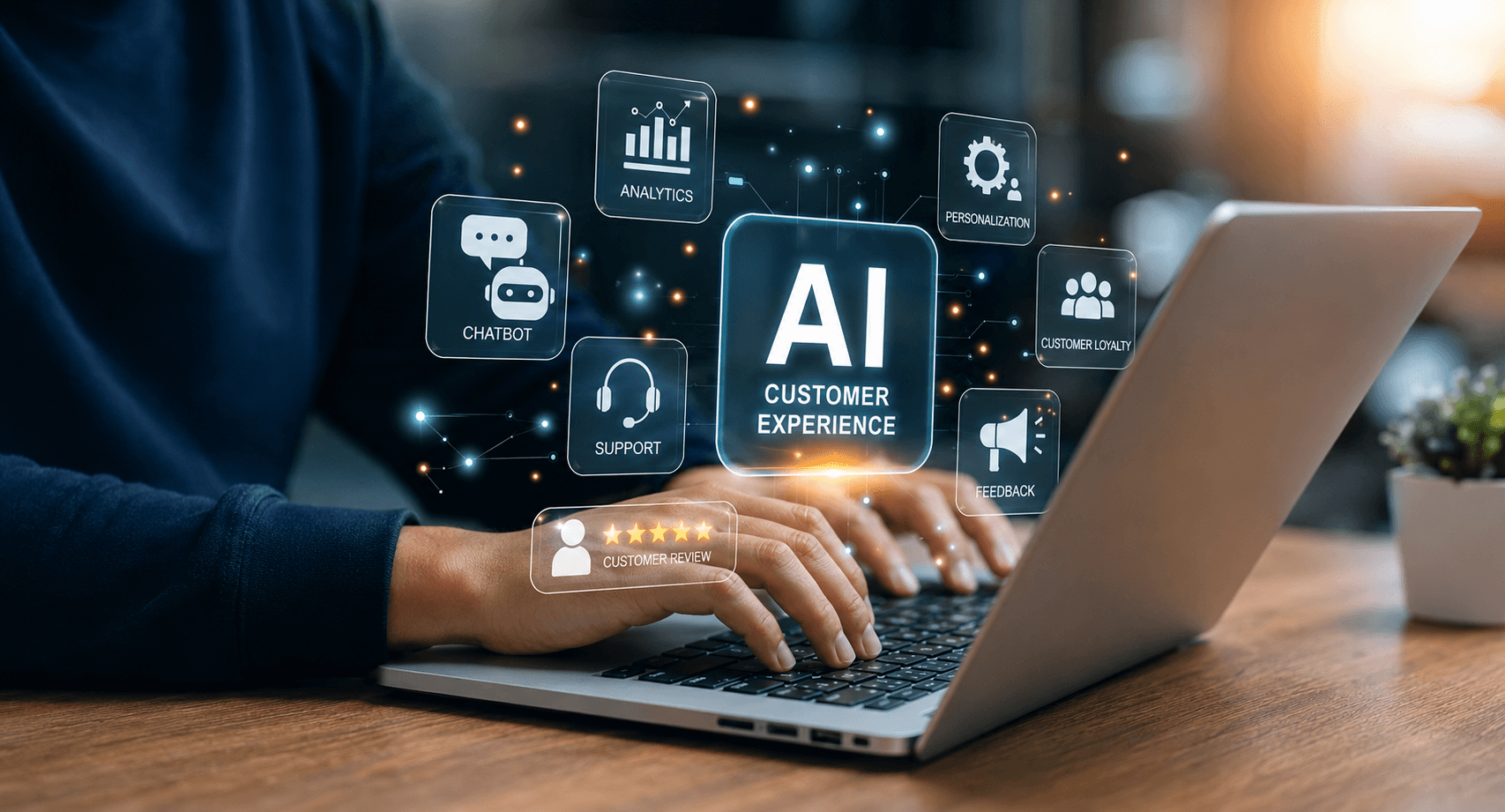
Customer expectations have never been higher. In 2026, customers expect instant responses, personalized interactions, seamless omnichannel experiences, and proactive support across every touchpoint. Businesses that fail to meet these expectations risk losing customers to competitors who can.
This is where Artificial Intelligence is transforming Customer Experience Management (CXM).
AI is no longer a futuristic concept. It has become a critical business tool that helps organizations understand customers better, automate repetitive tasks, predict customer needs, and deliver highly personalized experiences at scale.
From intelligent chatbots and predictive analytics to sentiment analysis and hyper personalization, AI is reshaping how businesses interact with customers. In this article, we explore how AI is changing Customer Experience Management in 2026 and why organizations are investing heavily in AI powered CX strategies.
What Is AI Powered Customer Experience Management?
 AI powered Customer Experience Management combines artificial intelligence, machine learning, automation, and data analytics to improve customer journeys across multiple channels.
The goal is simple:
- Understand customer behavior
- Anticipate customer needs
- Deliver personalized experiences
- Resolve issues faster
- Improve customer satisfaction
Organizations across industries are adopting AI to create smarter and more customer centric experiences.
According to research from the IBM Institute for Business Value, businesses that successfully integrate AI into customer experience strategies often see improvements in customer satisfaction, operational efficiency, and revenue growth.
Hyper Personalization Is Becoming the New Standard
One of the biggest ways AI is transforming Customer Experience Management is through hyper personalization.
Traditional personalization focused on basic customer information such as names, locations, or purchase history. AI takes personalization much further by analyzing:
- Browsing behavior
- Purchase patterns
- Customer preferences
- Engagement history
- Real time interactions
AI can recommend products, content, and services tailored specifically to each customer.
For example, streaming platforms, ecommerce brands, and financial service providers use AI algorithms to create highly personalized experiences that increase engagement and customer loyalty.
In 2026, customers increasingly expect businesses to understand their preferences without repeatedly providing the same information.
AI Chatbots Are Providing Instant Customer Support
Customer support has undergone significant transformation with the rise of AI powered chatbots.
Modern AI assistants can:
- Answer customer questions instantly
- Resolve common support issues
- Provide product recommendations
- Guide users through processes
- Escalate complex issues to human agents
Unlike traditional support systems, AI chatbots operate twenty four hours a day, seven days a week.
This ensures customers receive assistance whenever they need it while reducing support costs for businesses.
Generative AI models have also improved conversational capabilities, making interactions more natural and human like than ever before.
Predictive Analytics Helps Businesses Anticipate Customer Needs
One of AI’s most valuable contributions to Customer Experience Management is predictive analytics.
Instead of reacting to customer issues after they occur, businesses can proactively address problems before they impact customer satisfaction.
AI analyzes large datasets to identify patterns and predict:
- Customer churn risks
- Future purchasing behavior
- Support requirements
- Product preferences
- Customer lifetime value
This enables businesses to take preventive actions and strengthen customer relationships.
Predictive analytics allows organizations to move from reactive customer service to proactive customer engagement.
Sentiment Analysis Provides Deeper Customer Insights
Understanding customer emotions is essential for delivering exceptional experiences.
AI powered sentiment analysis helps businesses evaluate customer feedback from:
- Surveys
- Social media
- Reviews
- Emails
- Support interactions
Natural Language Processing technology identifies whether customer sentiment is positive, neutral, or negative.
This allows businesses to detect dissatisfaction early and respond before issues escalate.
Organizations can also use sentiment analysis to uncover trends and improve products, services, and customer communication strategies.
Omnichannel Experiences Are Becoming More Seamless
Customers interact with brands across multiple channels including websites, mobile apps, email, social media, live chat, and phone support.
AI helps unify these touchpoints into a seamless omnichannel experience.
For example:
A customer may begin a conversation through a chatbot, continue it via email, and later speak with a support representative.
AI ensures context is maintained throughout the journey, eliminating repetitive explanations and creating a smoother customer experience.
In 2026, consistency across channels has become a major competitive advantage.
AI Is Empowering Customer Service Teams
Contrary to popular belief, AI is not replacing customer service teams. Instead, it is empowering them.
AI tools assist support agents by:
- Suggesting responses
- Retrieving customer information
- Summarizing conversations
- Identifying next best actions
- Automating repetitive tasks
This allows human agents to focus on complex issues that require empathy, judgment, and relationship building.
The result is faster resolution times and improved customer satisfaction.
Voice AI and Conversational Intelligence Are Growing Rapidly
Voice technology is becoming increasingly important in Customer Experience Management.
AI powered voice assistants can:
- Handle support inquiries
- Route calls intelligently
- Analyze customer conversations
- Detect emotional cues
- Improve call center performance
Businesses are using conversational intelligence platforms to gain valuable insights from customer interactions and continuously improve service quality.
As voice interfaces become more sophisticated, customer interactions are expected to become even more natural and efficient.
AI Helps Deliver Proactive Customer Experiences
The most successful organizations are shifting from reactive service models to proactive customer experience strategies.
AI can identify potential issues before customers report them.
Examples include:
- Alerting customers about service disruptions
- Recommending account updates
- Providing maintenance reminders
- Detecting unusual activity
- Offering personalized support recommendations
Proactive engagement demonstrates that businesses understand and care about customer needs, strengthening trust and loyalty.
Challenges Businesses Must Address
While AI offers significant benefits, successful implementation requires careful planning.
Organizations must address challenges such as:
Data Privacy and Security
Customer data must be collected and managed responsibly while complying with privacy regulations.
Ethical AI Usage
Businesses should ensure transparency and fairness in AI driven decision making.
Human Oversight
AI should complement human expertise rather than replace it entirely.
Data Quality
AI systems rely on accurate, high quality data to generate meaningful insights and recommendations.
Organizations that address these challenges effectively are more likely to achieve successful AI adoption.
The Future of Customer Experience Management
Looking ahead, AI will continue to play a central role in Customer Experience Management.
Emerging technologies such as:
- Generative AI
- Conversational AI
- Predictive intelligence
- Autonomous customer support
- Real time personalization
will further redefine how businesses engage with customers.
The organizations that embrace AI strategically will be better positioned to deliver exceptional experiences while improving efficiency and profitability.
Conclusion
AI is fundamentally changing Customer Experience Management in 2026. From hyper personalization and predictive analytics to intelligent automation and proactive engagement, AI is helping businesses create more meaningful customer relationships than ever before.
Companies that leverage AI effectively can improve customer satisfaction, increase loyalty, reduce operational costs, and gain a significant competitive advantage.
As customer expectations continue to evolve, AI powered Customer Experience Management will become an essential component of business success.
Transform Customer Experience with PiHappiness
Deliver smarter customer journeys, actionable insights, and exceptional customer experiences with AI driven Customer Experience Management solutions.
Visit pihappiness to discover how PiHappiness helps organizations understand customer behavior, improve engagement, and create memorable customer experiences at scale.