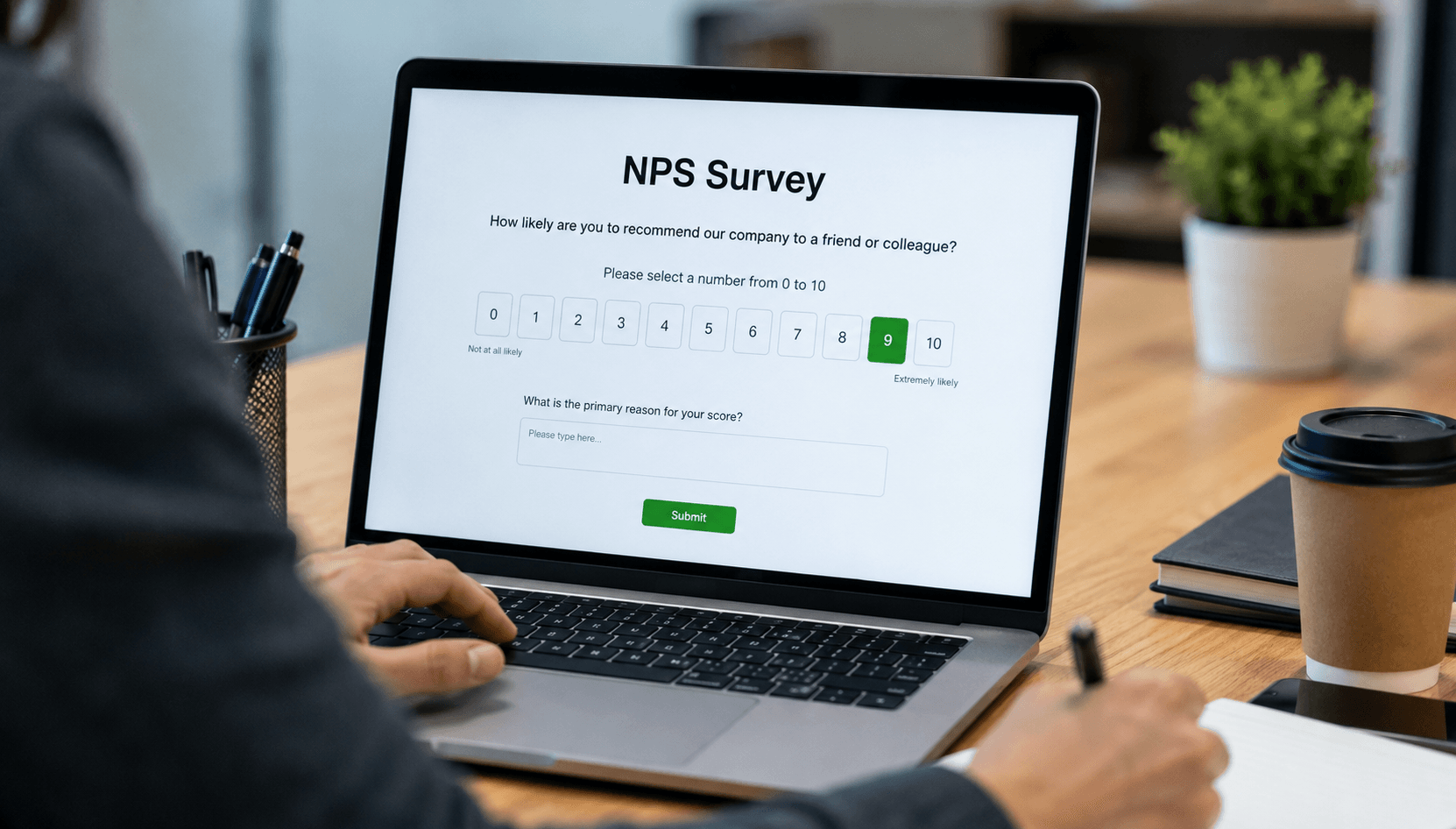
Net Promoter Score (NPS) surveys have become one of the most widely used tools for measuring customer loyalty and customer satisfaction. A well executed NPS survey can provide valuable insights into customer sentiment, identify areas for improvement, and help organizations strengthen customer relationships.
However, many businesses struggle with low NPS survey response rates. Even when customers are satisfied, they may choose not to participate if the survey experience is poorly designed or delivered at the wrong time.
A low response rate can lead to inaccurate data, skewed insights, and missed opportunities to improve the customer experience.
In this article, we explore the most common NPS survey mistakes that lower response rates and how businesses can optimize their customer feedback strategy to collect more meaningful responses.
Why NPS Response Rates Matter
The effectiveness of an NPS survey depends heavily on participation.
When response rates are low, businesses face several challenges:
- Limited customer insights
- Incomplete feedback data
- Sampling bias
- Reduced confidence in results
- Difficulty identifying trends
A strong response rate provides a more accurate picture of customer sentiment and enables organizations to make informed business decisions.
According to research published by the Qualtrics Experience Management Institute, collecting feedback consistently and making surveys easy to complete significantly improves participation and data quality.
Mistake 1: Sending Surveys at the Wrong Time
Timing plays a critical role in NPS survey success.
Many businesses send surveys days or weeks after a customer interaction. By then, the experience may no longer be fresh in the customer’s mind.
For example:
- A customer completes a purchase
- Customer support resolves an issue
- A service appointment concludes
Waiting too long to request feedback often results in lower engagement and lower response rates.
Best Practice
Send NPS surveys shortly after key customer interactions while the experience is still fresh and relevant.
Mistake 2: Making Surveys Too Long
One of the biggest reasons customers abandon surveys is length.
An NPS survey is designed to be simple. The primary question asks:
“How likely are you to recommend our company to a friend or colleague?”
Many organizations make the mistake of adding numerous follow up questions that turn a quick survey into a lengthy questionnaire.
The more effort required, the less likely customers are to participate.
Best Practice
Keep surveys concise.
Focus on:
- The NPS question
- One optional open ended comment field
- A few relevant follow up questions if absolutely necessary
Short surveys consistently achieve higher completion rates.
Mistake 3: Survey Fatigue from Over Surveying Customers
Customers are frequently asked for feedback across multiple channels.
They may receive surveys after:
- Purchases
- Support interactions
- Product usage
- Website visits
- Marketing campaigns
When customers receive too many surveys, participation naturally declines.
This phenomenon is known as survey fatigue.
Best Practice
Establish clear survey frequency rules.
Avoid repeatedly surveying the same customer within short time periods.
Respecting customer attention improves long term engagement.
Mistake 4: Poor Mobile Survey Experience
In 2026, most customers interact with brands through mobile devices.
Yet many organizations continue to design surveys primarily for desktop users.
Common issues include:
- Small buttons
- Difficult navigation
- Slow loading pages
- Poor responsiveness
A frustrating mobile experience often causes customers to abandon surveys before completion.
Best Practice
Ensure every NPS survey is fully optimized for mobile devices.
Test surveys across multiple screen sizes before deployment.
Mistake 5: Generic Survey Invitations
Customers are more likely to respond when they feel the request is personal and relevant.
Generic email invitations such as:
“Please complete our survey.”
often fail to capture attention.
Customers may ignore or delete these requests without opening them.
Best Practice
Personalize survey invitations using:
- Customer names
- Recent interactions
- Relevant context
For example:
“We’d love your feedback on your recent support experience.”
Personalized requests often generate higher engagement.
Mistake 6: Failing to Explain Why Feedback Matters
Many organizations ask for feedback without explaining its purpose.
Customers are more willing to participate when they understand how their responses will be used.
If customers believe feedback disappears into a system with no impact, they may not see value in responding.
Best Practice
Clearly communicate:
- Why feedback is important
- How responses help improve customer experience
- What actions may result from customer input
Transparency increases participation and trust.
Mistake 7: Asking Leading Questions
Survey questions should be neutral and unbiased.
Leading questions can influence responses and reduce the credibility of feedback data.
Examples include:
- “How much did you enjoy our excellent service?”
- “Would you agree that our support team was helpful?”
These questions create bias and compromise survey quality.
Best Practice
Use objective language that allows customers to provide honest feedback.
Accurate insights are more valuable than artificially inflated scores.
Mistake 8: Ignoring Open Ended Feedback
Many organizations focus exclusively on NPS scores while overlooking customer comments.
The score indicates customer sentiment, but comments explain why customers feel that way.
Ignoring qualitative feedback can lead to missed opportunities for improvement.
Best Practice
Analyze open ended responses alongside NPS scores.
Look for recurring themes related to:
- Product issues
- Customer service
- User experience
- Pricing concerns
- Feature requests
This context often provides the most actionable insights.
Mistake 9: Not Closing the Feedback Loop
One of the fastest ways to reduce future response rates is failing to act on customer feedback.
Customers notice when they repeatedly share suggestions without seeing any improvements.
Over time, they become less willing to participate.
Best Practice
Demonstrate that feedback drives action.
Organizations can:
- Follow up with customers
- Share improvements
- Communicate changes made based on feedback
Closing the feedback loop strengthens customer trust and encourages future participation.
Mistake 10: Using a One Size Fits All Survey Strategy
Different customer segments often require different approaches.
For example:
- New customers
- Long term customers
- Enterprise clients
- Ecommerce shoppers
Each group may respond differently to survey timing, channels, and messaging.
Using the same strategy for every audience can limit response rates.
Best Practice
Segment customers and tailor survey experiences based on:
- Customer journey stage
- Purchase behavior
- Industry
- Relationship history
Personalized survey strategies typically generate better results.
How AI Is Improving NPS Survey Response Rates
Artificial Intelligence is helping organizations improve survey engagement and customer feedback collection.
AI powered Customer Experience platforms can:
- Predict optimal survey timing
- Personalize survey invitations
- Identify response patterns
- Detect customer sentiment
- Automate feedback analysis
By using AI driven insights, businesses can improve participation while reducing survey fatigue.
Organizations increasingly use AI to ensure surveys reach the right customer at the right time through the right channel.
Best Practices for Increasing NPS Survey Response Rates
To maximize participation, organizations should focus on the following:
- Keep surveys short and simple
- Optimize for mobile devices
- Personalize survey invitations
- Send surveys at the right time
- Limit survey frequency
- Explain the value of feedback
- Follow up on customer responses
- Analyze qualitative feedback
- Use AI driven survey optimization
Small improvements in survey design can lead to significant increases in response rates and data quality.
Conclusion
NPS surveys remain one of the most effective tools for measuring customer loyalty and customer satisfaction. However, even the best survey programs can fail if customers are unwilling to participate.
Mistakes such as poor timing, lengthy surveys, survey fatigue, generic invitations, and failure to act on feedback can significantly reduce response rates.
Organizations that focus on creating a simple, personalized, and customer friendly survey experience are far more likely to collect meaningful feedback and generate actionable insights.
By avoiding these common NPS survey mistakes, businesses can improve response rates, strengthen customer relationships, and build more effective Customer Experience Management strategies.
Improve Your Customer Feedback Strategy with PiHappiness
Transform customer feedback into actionable business insights with PiHappiness. Measure customer sentiment, improve NPS survey performance, and create exceptional customer experiences using advanced Customer Experience Management solutions.
Visit pihappiness to discover how PiHappiness helps organizations collect better feedback, improve response rates, and drive customer loyalty.