
Customers expect more than a good product or service. They also expect businesses to make every interaction simple.
They want to find answers quickly, complete purchases without unnecessary steps, resolve issues without repeating themselves, and get help without being transferred between multiple departments.
When customers have to work too hard to accomplish something, they experience friction in the customer journey.
This is where Customer Effort Score (CES) becomes valuable.
Customer Effort Score is a customer experience metric that helps businesses understand how easy or difficult customers find a specific interaction, task, or process.
Instead of asking only whether customers are satisfied, CES asks a different and equally important question:
“How easy was it for you to get what you needed?”
Understanding customer effort can help businesses discover hidden problems in customer journeys, improve processes, reduce friction, and create easier experiences.
In this guide, we explain what Customer Effort Score means, how it works, how to measure it, where to use it, and how businesses can turn CES feedback into meaningful customer experience improvements.
What Is Customer Effort Score?
Customer Effort Score (CES) is a customer experience metric used to measure how much effort a customer feels they had to make to complete a particular task or resolve an issue.

A CES survey might ask:
“How easy was it to resolve your issue today?”
Customers then provide a rating using a defined scale.
For example:
1 – Very difficult
2 – Difficult
3 – Neither easy nor difficult
4 – Easy
5 – Very easy
The exact scale can vary between businesses.
The important part is consistency.
If customers repeatedly report that an interaction was difficult, the business has an opportunity to investigate what is creating that difficulty.
Customer effort can occur across almost every stage of the customer journey, including:
- Searching for information
- Purchasing a product
- Booking a service
- Completing onboarding
- Contacting support
- Returning a product
- Managing an account
- Cancelling a service
- Renewing a subscription
CES helps businesses understand these experiences from the customer’s perspective.
Why Does Customer Effort Matter?
A customer can be satisfied with the final outcome and still feel that the process was unnecessarily difficult.
Imagine a customer has a billing problem.
They contact support, explain the issue, get transferred to another department, repeat the information, wait for a response, and eventually receive a solution.
The problem has been resolved.
But the customer had to put in significant effort to get there.
That experience matters.
High customer effort can be caused by:
- Long waiting times
- Complicated processes
- Multiple support transfers
- Repeating information
- Confusing instructions
- Difficult website navigation
- Long forms
- Poor self-service
- Unclear communication
- Too many approval steps
Reducing these obstacles can make the customer journey smoother.
This is one reason businesses should measure more than satisfaction alone.
Customer Effort Score vs. CSAT
CES and Customer Satisfaction Score (CSAT) are related but measure different aspects of the customer experience.

CSAT asks:
“How satisfied were you?”
CES asks:
“How easy or difficult was the experience?”
For example, a customer might give a high satisfaction rating because their support problem was eventually resolved.
However, their CES response could indicate that the process was difficult because they had to contact support several times.
This is why CES can complement CSAT.
Businesses can use CSAT to understand satisfaction and CES to identify friction.
For a broader look at customer experience measurement, see Customer Satisfaction Survey with Questions & Examples, which covers customer satisfaction surveys and key CX metrics.
How Is Customer Effort Score Calculated?
CES is generally measured using a rating question and a consistent scale.
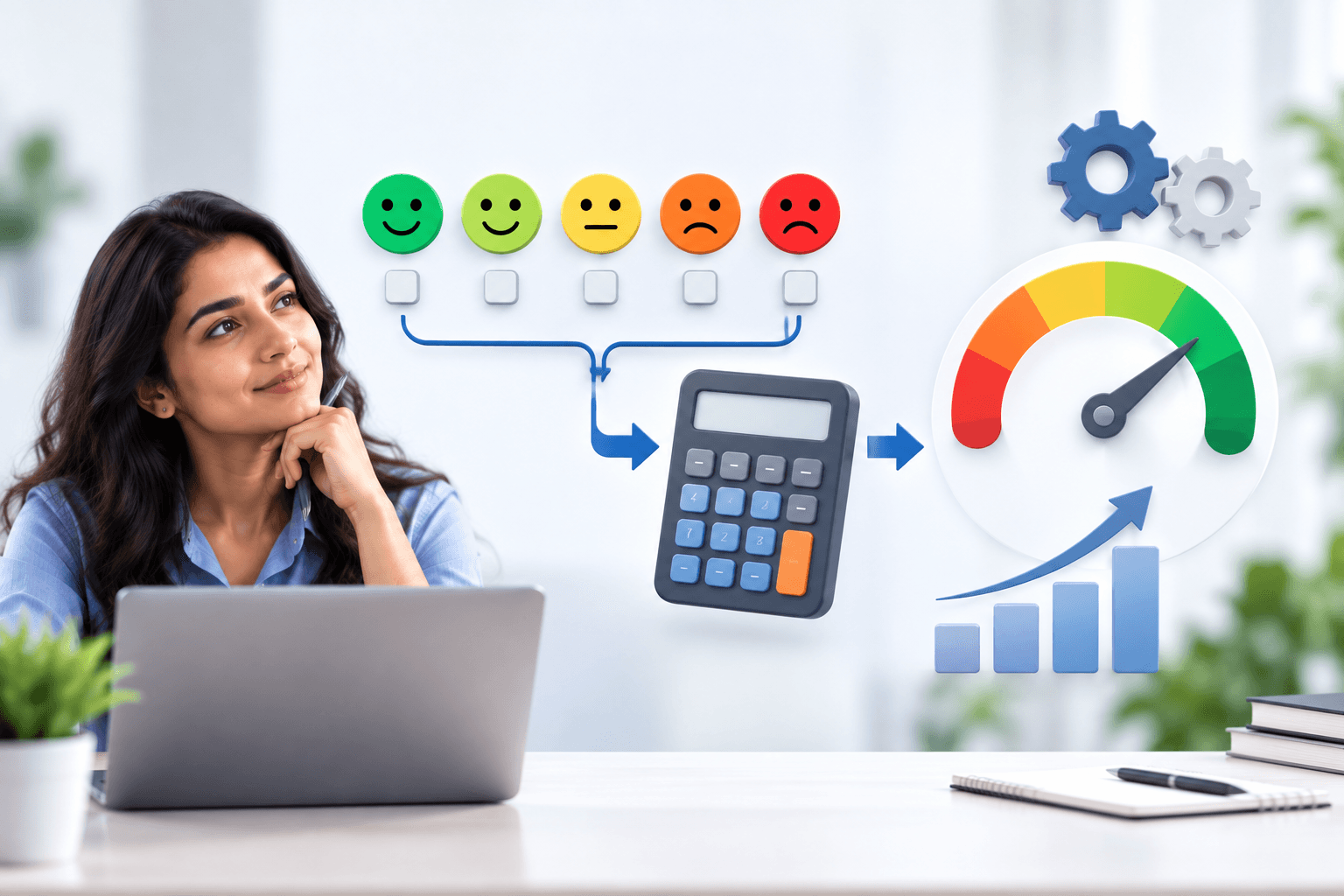
For example, suppose five customers rate an interaction on a scale from 1 to 5:
5, 4, 4, 3, 5
The average score would be:
(5 + 4 + 4 + 3 + 5) ÷ 5 = 4.2
The business can track this score over time.
However, businesses should define whether a higher score means less effort or more effort.
For example:
1 = Very difficult and 5 = Very easy
means a higher score represents a better, lower-effort experience.
Another survey could use the opposite direction.
Therefore, CES results should always be interpreted according to the exact question and scale being used.
For a broader overview of how CES fits alongside other customer experience metrics, see Learn Measuring Customer Satisfaction with CSAT, CES, and NPS Surveys.
What Does a Good CES Score Mean?
There is no universal CES score that every business should aim for.
The interpretation depends on:
- Rating scale
- Question wording
- Industry
- Customer interaction
- Customer expectations
- Historical performance
Instead of focusing only on an industry benchmark, businesses should look for trends within their own customer experience.
For example, if the average CES for customer support improves from 3.2 to 4.1 after a process change, that may indicate that the new process is making the experience easier.
Businesses should also look at the distribution of responses.
An average score can hide important differences.
For example:
Customer A: 5
Customer B: 5
Customer C: 5
Customer D: 1
The average may look reasonable, but one customer has experienced extremely high effort.
That is why individual responses and comments can be important.
Where Can Businesses Use CES?
Customer Effort Score can be used at many customer touchpoints.

- Customer Support
After a support interaction, ask:
“How easy was it to resolve your issue?”
Low scores can highlight problems with:
- Response times
- Transfers
- Resolution processes
- Communication
- Agent availability
- Online Checkout
Businesses can measure how easy customers found the checkout process.
High effort may be caused by:
- Too many checkout steps
- Complicated payment options
- Account requirements
- Technical problems
- Confusing information
- Product Returns
Returning a product can create significant customer effort.
CES can help businesses understand whether customers find the return process simple or difficult.
- Account Management
Customers may need to update personal information, payment details, subscriptions, or account preferences.
If these processes require unnecessary steps, CES can highlight the problem.
- Service Booking
Booking a service should be straightforward.
If customers need multiple calls or have difficulty finding available times, the booking journey may create unnecessary effort.
- Customer Onboarding
New customers often need to complete several steps before they can fully use a product or service.
CES can help businesses identify where customers struggle during onboarding.
How CES Helps Identify Customer Journey Friction
The biggest advantage of CES is its ability to highlight specific points of friction.
Consider this simplified customer journey:
Discover → Compare → Purchase → Onboard → Use → Get Support → Renew
A business could measure CES at different stages.
For example:
| Journey Stage | CES |
| Product Search | 4.6 |
| Purchase | 4.4 |
| Onboarding | 3.2 |
| Product Use | 4.1 |
| Customer Support | 2.8 |
| Renewal | 4.3 |
The overall experience might appear healthy.
But the data immediately highlights two areas:
Onboarding
and
Customer Support
These stages deserve further investigation.
Instead of attempting to improve every part of the customer journey, teams can focus resources on the areas creating the greatest friction.
Common Sources of Customer Effort
A low CES score tells you that customers are experiencing difficulty.
The next question is:
Why?
Repeating Information
Customers become frustrated when they have to explain the same problem multiple times.
Long Waiting Times
Even a simple request can become frustrating when customers have to wait too long.
Complicated Processes
Too many steps can increase effort and create unnecessary friction.
Poor Navigation
Customers may struggle to find information on a website or application.
Long Forms
Customers may abandon a process if they are required to provide too much information.
Multiple Transfers
Customers should not have to navigate a company’s internal organizational structure.
Unclear Instructions
If instructions are confusing, customers may need additional support.
Lack of Self-Service
Customers may contact support for simple questions if answers are difficult to find.
Measure CES at the Right Moment
Timing is important.
If a business wants to measure support effort, the CES survey should be connected to the support interaction.
If the goal is to measure checkout effort, the survey should appear after checkout.
If the goal is to measure onboarding effort, it should be measured after the customer has experienced the onboarding process.
The closer the survey is to the relevant experience, the more specific the feedback can be.
For example:
Support interaction → CES survey
is more directly connected than:
Support interaction → several weeks → CES survey
Timely measurement also makes it easier to identify the process that caused the customer’s experience.
Keep CES Surveys Short
A survey designed to measure customer effort should not require significant effort to complete.
Keep CES surveys focused.
For example:
How easy was it to resolve your issue?
Very difficult – Very easy
Then provide an optional follow-up:
What made the experience difficult or easy?
This approach gives customers an opportunity to provide additional context without making the survey unnecessarily long.
Keeping feedback requests simple is also important when building a wider customer feedback strategy.
Combine CES With Customer Comments
A numerical score tells you what happened.
A customer comment can help explain why it happened.
For example:
CES: 2/5
Customer comment:
“I had to contact support three times and explain the problem to a different person each time.”
The score identifies high effort.
The comment points toward a possible cause:
Poor support handoff.
Businesses can then investigate the internal process.
This combination of quantitative and qualitative feedback is important when turning survey results into action.
For additional guidance on turning customer responses into useful insights, see Customer Feedback Analysis: A Guide to Analyzing & Acting on It.
Analyze CES by Customer Segment
An overall CES score may hide differences between customer groups.
For example, a business might have a healthy overall CES but discover that new customers experience significantly more effort than existing customers.
Businesses can analyze CES by:
- New vs. existing customers
- Product
- Service
- Location
- Customer segment
- Issue type
- Interaction type
- Channel
This can reveal specific customer groups that need additional attention.
Compare CES Across Channels
The same customer journey can produce different levels of effort depending on the channel.
For example:
| Channel | CES |
| Website | 4.6 |
| Mobile App | 4.5 |
| Live Chat | 4.1 |
| Phone | 3.3 |
| 2.9 |
If email support consistently produces a lower CES, the business can investigate response times, communication, case ownership, or resolution processes.
Channel-level analysis makes CES more actionable.
Use CES to Improve Self-Service
Self-service is designed to make customer interactions easier.
But having a knowledge base or help center does not automatically mean customers can find what they need.
Customers may still experience high effort because:
- Search results are poor
- Articles are difficult to understand
- Information is outdated
- Important answers are difficult to locate
- Instructions contain too many steps
Businesses can use CES to evaluate self-service.
For example:
“How easy was it to find the information you needed?”
If customers consistently report high effort, businesses can investigate the self-service experience.
The solution might involve better search, clearer article titles, simpler instructions, or improved navigation.
Use CES to Identify Service Recovery Opportunities
A very low CES score combined with a negative comment may indicate that a customer needs attention.
For example:
CES: Very difficult
Comment: “I’ve contacted support four times and still haven’t received a solution.”
This type of feedback could trigger an internal alert.
A possible workflow is:
Low CES → Alert → Review → Assign → Resolve → Follow Up
This connects customer feedback with service recovery.
It also helps prevent important feedback from simply becoming another number in a dashboard.
Track CES Over Time
CES becomes more useful when businesses monitor it consistently.
For example:
| Month | Average CES |
| January | 3.4 |
| February | 3.5 |
| March | 3.8 |
| April | 4.1 |
| May | 4.3 |
The trend suggests that customer effort is decreasing.
Businesses can then investigate what changed during this period.
Perhaps they:
- Simplified a process
- Improved support training
- Reduced transfers
- Redesigned checkout
- Improved self-service
- Reduced form fields
Tracking CES over time helps businesses determine whether customer experience initiatives are producing measurable improvements.
Common CES Measurement Mistakes
Measuring Without a Clear Objective
Decide what interaction you want to understand before creating the survey.
Using Inconsistent Scales
Changing question formats or rating directions can make comparisons difficult.
Asking Too Many Questions
Long surveys can create additional customer effort.
Asking Too Late
Delayed surveys may make it harder for customers to connect the feedback with a specific experience.
Ignoring Comments
Comments can provide important context behind CES scores.
Focusing Only on the Average
Look at individual responses, segments, channels, and trends.
Collecting Feedback Without Taking Action
CES should support improvement rather than simply create another reporting metric.
How to Improve Customer Effort Score
Once a business identifies friction, it can take practical steps to reduce unnecessary effort.

Simplify Processes
Remove unnecessary steps, forms, approvals, and requirements.
Improve Communication
Give customers clear instructions and timely updates.
Reduce Repetition
Make relevant customer information available to the right teams.
Improve Employee Handoffs
Customers should not have to repeat their issue whenever a case moves between departments.
Strengthen Self-Service
Make common answers easier to find.
Improve Digital Experiences
Reduce unnecessary clicks and make important actions easy to complete.
Empower Employees
Give frontline employees the tools and information needed to resolve common issues.
Measure Again
After implementing a change, measure CES again.
The objective is to determine whether customer effort actually decreased.
CES Should Work With Other CX Metrics
CES provides valuable information, but it should not be viewed in isolation.
Businesses can combine CES with:
- CSAT
- NPS
- Customer retention
- Complaint volume
- Resolution time
- Response time
- Customer comments
- Repeat contact rate
Each metric answers a different question.
CSAT: How satisfied are customers?
NPS: How likely are customers to recommend the business?
CES: How easy or difficult was the experience?
Understanding these differences helps businesses select the right metric for the right customer journey.
For another useful comparison of customer experience metrics, see NPS® vs. CSAT: Which Customer Experience Metric is Best.
From Measuring Effort to Reducing Friction
Collecting CES data is only the first step.
The real value comes from what happens afterward.
A practical process is:
Measure → Identify → Investigate → Improve → Measure Again
First, measure customer effort.
Then identify where effort is highest.
Investigate the root cause.
Make the appropriate improvement.
Finally, measure again to determine whether the experience became easier.
This creates a continuous feedback loop.
Customers do not want unnecessary work.
They want simple processes, clear information, quick answers, and efficient solutions.
Customer Effort Score helps businesses understand where customers are experiencing unnecessary difficulty across the customer journey.
Whether the friction happens during checkout, onboarding, support, returns, booking, or self-service, CES can help businesses identify where improvement is needed.
But the goal is not simply to achieve a higher CES score.
The real goal is to understand why customers are experiencing friction and what the business can do to remove it.
A strong approach is:
Measure → Identify → Investigate → Improve → Measure Again
When businesses consistently reduce unnecessary effort, they can create smoother customer journeys and make it easier for customers to accomplish what they need.
The most valuable question is therefore not only:
“What is our Customer Effort Score?”
It is:
“What are we making unnecessarily difficult for our customers?”
Answering that question can turn CES from a simple survey metric into a practical tool for improving the entire customer experience.
Frequently Asked Questions
- What is Customer Effort Score (CES)?
Customer Effort Score is a customer experience metric that measures how easy or difficult customers find a particular interaction, task, or process.
- What does Customer Effort Score measure?
CES measures the amount of effort customers feel they had to make to complete a task or resolve an issue. It can help businesses identify friction across the customer journey.
- How is Customer Effort Score calculated?
CES is generally measured using a standardized customer effort question and rating scale. Businesses can calculate an average score or analyze the percentage of customers reporting different levels of effort.
- What is a good Customer Effort Score?
There is no universal good CES score because businesses can use different rating scales and question formats. Businesses should focus on consistent measurement and improving their own customer effort trends.
- What is the difference between CES and CSAT?
CSAT measures customer satisfaction, while CES measures how easy or difficult an interaction was. Using both metrics can help businesses understand different aspects of the customer experience.
- When should a CES survey be sent?
A CES survey should generally be sent shortly after the specific interaction or task being measured, such as customer support, checkout, onboarding, returns, or booking.
- How does CES identify friction in the customer journey?
CES can show which customer journey stages require more effort. Businesses can compare scores across touchpoints, channels, products, or customer segments to identify areas that need improvement.
- What causes high customer effort?
High customer effort can result from complicated processes, long waiting times, repeated information requests, difficult forms, poor navigation, multiple support transfers, unclear communication, and limited self-service.
- Can CES improve customer experience?
Yes. CES can help businesses identify difficult customer interactions and prioritize improvements that make processes simpler and easier.
- Can CES be used for customer support?
Yes. CES is particularly useful after customer support interactions because it can help businesses understand how easy or difficult it was for customers to resolve their issues.
- Should businesses use CES with CSAT and NPS?
Yes. CES, CSAT, and NPS measure different aspects of customer experience. Using them together can provide a broader understanding of effort, satisfaction, and customer loyalty.
- How can businesses reduce customer effort?
Businesses can reduce customer effort by simplifying processes, improving self-service, reducing unnecessary steps, improving communication, strengthening team handoffs, and making digital experiences easier to navigate.