
Customer feedback gives businesses something that internal reports cannot provide on their own: the customer’s perspective.
Customers can tell you what they like, what frustrates them, what they expect, and where their experience falls short. But collecting useful feedback requires more than sending the occasional survey.
Businesses have many ways to collect customer feedback, from online surveys and interviews to reviews, social media, in-app feedback, and customer support conversations. The challenge is choosing the right methods and using them at the right points in the customer journey.
A strong feedback strategy combines different methods to capture both quantitative and qualitative insights.
In this guide, we’ll explore 15 customer feedback methods businesses can use to collect better insights and turn customer opinions into meaningful improvements.
What Is Customer Feedback?
Customer feedback is information customers share about their experience with a product, service, interaction, or brand.

It can include:
- Ratings and scores
- Survey responses
- Reviews
- Comments
- Complaints
- Suggestions
- Interviews
- Social media posts
- Support conversations
- Product feedback
Customer feedback can be broadly divided into two forms.
Quantitative feedback provides measurable information, such as ratings, NPS and CSAT scores.
Qualitative feedback provides more detailed information through comments, reviews, interviews, and open-ended responses.
Both are valuable because numbers can show what is happening, while customer comments can help explain why it is happening.
For a deeper explanation, see the piHappiness guide on What Is Customer Feedback: Benefits, Tips, and Best Tools.
15 Customer Feedback Methods
Online Customer Surveys
Online surveys are one of the most common ways to collect structured customer feedback.
Businesses can send surveys through email, SMS, website links, QR codes, or other digital channels.

Online surveys can be used to measure:
- Customer satisfaction
- Product satisfaction
- Service quality
- Customer loyalty
- Purchase experience
- Post-support experience
Keep surveys focused and easy to complete. Asking too many questions can make the experience harder for customers and may reduce participation.
For ongoing feedback programs, online surveys are particularly useful because responses can be collected and organized digitally.
NPS Surveys
Net Promoter Score, or NPS, is commonly used to understand customer loyalty and willingness to recommend a business.
A typical NPS question asks customers how likely they are to recommend a company, product, or service.
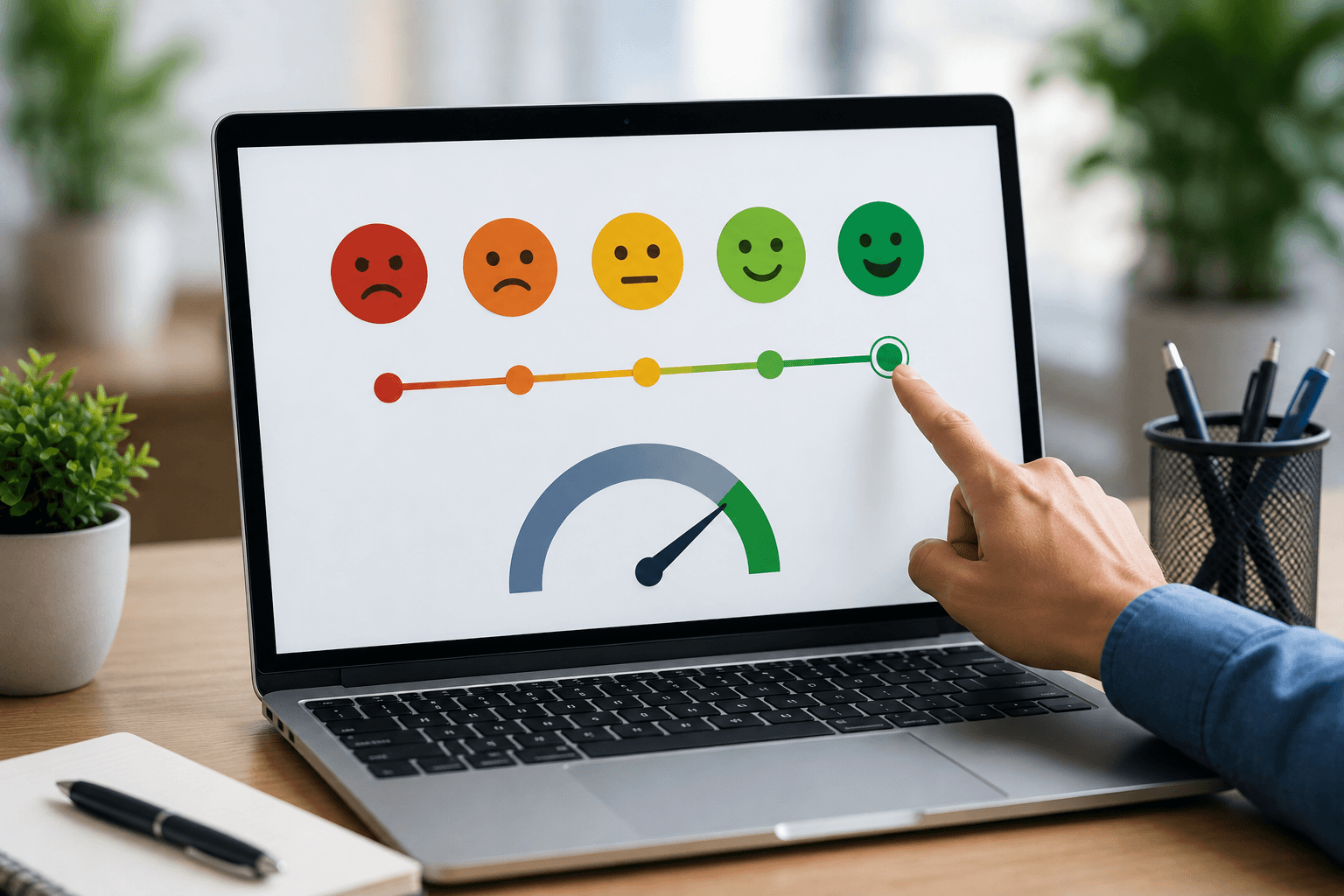
The result can help businesses track changes in customer loyalty over time.
However, NPS should not be viewed in isolation. Follow-up questions can help explain why customers gave a particular score.
If you’re comparing customer experience metrics, see the piHappiness guide on NPS vs. CSAT: Which Customer Experience Metric Is Best.
CSAT Surveys
Customer Satisfaction Score, or CSAT, measures how satisfied customers are with a particular interaction, product, service, or experience.
CSAT surveys are often useful immediately after a customer interaction.
For example, after a support conversation, you could ask:
“How satisfied were you with the support you received?”
A follow-up question can then ask customers to explain their rating.
This gives businesses both a measurable satisfaction indicator and additional context.
Customer Interviews
Customer interviews provide detailed qualitative feedback that surveys may not capture.
A conversation allows businesses to ask follow-up questions and explore customer experiences in greater depth.
Interviews can help uncover:
- Customer motivations
- Expectations
- Frustrations
- Product challenges
- Unmet needs
- Reasons behind purchasing decisions
For best results, avoid turning interviews into sales conversations.
The objective is to listen and understand.
Online Reviews
Customer reviews can provide valuable unsolicited feedback.
Customers often discuss:
- Product quality
- Service experience
- Delivery
- Staff behavior
- Pricing
- Customer support
- Overall satisfaction
Reviews can also reveal recurring issues that customers may not mention in formal surveys.
Businesses should monitor reviews regularly and look for patterns rather than focusing only on individual comments.
Social Media Feedback
Customers frequently share opinions about brands through social media.

This can include:
- Comments
- Mentions
- Direct messages
- Posts
- Poll responses
- Public complaints
- Recommendations
Social media feedback can provide a real-time view of how customers are talking about your brand.
However, not every comment represents the overall customer base. Treat social feedback as one source within a broader feedback strategy.
Website Feedback Forms
A simple feedback form on your website can give visitors a direct way to share their experience.
You could ask:
- Was this page helpful?
- Did you find what you were looking for?
- What could we improve?
- Was anything difficult to understand?
Website feedback can be particularly useful for identifying usability problems and content gaps.
Instead of asking every visitor for detailed feedback, consider using short questions at relevant points in the customer journey.
In-App Feedback
For businesses with mobile or web applications, in-app feedback can capture customer opinions while users are actively interacting with the product.
For example, after using a particular feature, users could be asked:
“How easy was this feature to use?”
In-app feedback can help product teams identify usability problems and understand which features customers value.
Because feedback is collected close to the actual experience, customers may be able to provide more specific information.
Customer Support Conversations
Customer support teams interact with customers who often have specific problems or questions.
Support conversations can therefore be an important source of customer feedback.
Look for recurring topics such as:
- Frequently reported problems
- Product confusion
- Service delays
- Repeated questions
- Feature requests
- Complaints
- Resolution difficulties
Support feedback is particularly valuable because it can reveal problems that customers are actively trying to solve.
Live Chat Feedback
Live chat can capture feedback while customers are interacting with your business.
Customers may mention:
- Website difficulties
- Product questions
- Service problems
- Pricing concerns
- Purchase barriers
- Support issues
You can also ask customers to rate their chat experience after the conversation.
This combines direct customer comments with a measurable satisfaction indicator.
Focus Groups
Focus groups bring several customers together to discuss a product, service, concept, or experience.
They can be useful when a business wants to explore different opinions and understand how customers react to a particular idea.
Focus groups can help answer questions such as:
- What do customers think about a new product?
- Which features matter most?
- What concerns do customers have?
- How do customers describe their needs?
- What improvements would they like?
Because focus groups involve discussion, they can produce detailed qualitative information.
However, group discussions should be carefully moderated to avoid allowing one participant’s opinion to dominate the conversation.
Customer Feedback Forms
Traditional feedback forms can still be useful, especially at physical locations.
They can be used in:
- Retail stores
- Hotels
- Restaurants
- Hospitals
- Service centers
- Events
A feedback form should be short and focused on the experience you want to measure.
For example, a hotel might ask about check-in, room experience, cleanliness, and service.
The method may be simple, but the information can become valuable when responses are consistently collected and analyzed.
Customer Effort Surveys
Customer Effort Score, or CES, focuses on how easy or difficult it was for customers to complete an interaction.
For example:
“How easy was it to resolve your issue today?”
This method can help identify friction in processes such as:
- Customer support
- Returns
- Payments
- Account management
- Website navigation
- Product onboarding
A high-effort experience can indicate an opportunity to simplify the customer journey.
Customer Satisfaction Research
Customer satisfaction research goes beyond a single survey question.
It is a structured approach to understanding how satisfied customers are with a product, service, or overall experience.
It can combine:
- Surveys
- Interviews
- Feedback forms
- Satisfaction scores
- Customer comments
- Behavioral information
This approach can help businesses identify both satisfied and dissatisfied customer groups.
The piHappiness article What Is Customer Satisfaction Research and How to Conduct It? provides further information on using structured research to understand customer satisfaction.
Voice of Customer Programs
A Voice of Customer, or VoC, program brings different customer feedback sources together into a structured process.
Instead of looking at surveys, reviews, support conversations, and social media separately, businesses can analyze them together to identify broader patterns.
A VoC program can help answer:
- What do customers need?
- What are their biggest pain points?
- What do they value?
- Where is the experience improving?
- Where are problems recurring?
For businesses looking to build a broader VoC approach, the piHappiness article 10 Best Voice of Customer Tools to Enhance CX explores tools and capabilities used for collecting and analyzing customer input.
How to Choose the Right Customer Feedback Method
There is no single feedback method that works for every business.
Consider these factors before choosing your approach:
| Business Need | Suitable Methods |
| Measure satisfaction | CSAT surveys, feedback forms |
| Measure loyalty | NPS surveys |
| Understand detailed opinions | Interviews, focus groups |
| Identify website problems | Website feedback |
| Improve an app | In-app feedback |
| Monitor public opinions | Online reviews, social media |
| Identify support issues | Support conversations, live chat |
| Measure process difficulty | CES surveys |
| Build a complete CX view | VoC program, multi-channel feedback |
The best strategy often combines multiple methods.
For example, a company could use NPS to measure loyalty, CSAT after support interactions, online reviews to monitor public feedback, and customer interviews to understand deeper customer needs.
How to Collect Better Customer Feedback
Choosing the right method is important, but the quality of your feedback also depends on how you collect it.
Ask Specific Questions
Avoid vague questions such as:
“Do you like our product?”
Instead, ask questions that focus on a specific experience.
For example:
“How satisfied are you with the product’s ease of use?”
Specific questions produce more useful information.
Keep Surveys Short
Only ask questions that serve a clear purpose.
If a question will not influence a decision, consider removing it.
Combine Ratings With Open-Ended Questions
A rating can show the level of satisfaction.
An open-ended question can explain the reason.
For example:
Rating:
“How satisfied are you with our service?”
Open-ended:
“What is the main reason for your rating?”
This combination can produce both quantitative and qualitative insights.
Ask for Feedback at the Right Time
Timing can influence the quality of feedback.
Ask for feedback close to the experience you want customers to evaluate.
For example:
- After a purchase
- After customer support
- After onboarding
- After using a product feature
- After completing a service
Use Multiple Channels
Customers have different communication preferences.
Some may respond to email surveys, while others may prefer SMS, QR codes, website forms, or in-app feedback.
Using appropriate channels can help businesses reach customers at different touchpoints.
Analyze Feedback Instead of Just Collecting It
Collecting hundreds of responses does not automatically create valuable insights.
Businesses need to identify:
- Common themes
- Recurring complaints
- Positive experiences
- Customer pain points
- Sentiment
- Trends
- Differences between customer segments
The piHappiness guide Customer Feedback Analysis: A Guide to Analyzing & Acting on It explains how businesses can organize, categorize, analyze, and act on both quantitative and qualitative customer feedback.
Turn Customer Feedback Into Action
The final step is the most important.
Feedback should lead to action.
A simple framework is:
Collect → Analyze → Identify → Act → Measure
For example:
Feedback:
Customers say the checkout process is difficult.
Insight:
Customers are experiencing friction during checkout.
Action:
Simplify the checkout process.
Measurement:
Track customer satisfaction and checkout-related feedback after the change.
This creates a feedback loop where customer opinions influence improvements.
Why Customer Feedback Analysis Matters
Raw feedback can contain thousands of individual opinions.
The value comes from finding the patterns within that information.
For example, one customer complaining about slow support may be an isolated issue.
If many customers mention the same problem, it becomes a trend worth investigating.
This is why businesses need a structured approach to customer feedback analysis.
Tools that can categorize feedback, identify trends, analyze sentiment, and create reports can help teams process larger volumes of information more efficiently.
Common Customer Feedback Mistakes
Collecting Feedback Without a Goal
Every feedback initiative should have a clear objective.
Asking Too Many Questions
Long surveys can create unnecessary friction.
Relying on Only One Channel
A single channel may not represent the complete customer experience.
Looking Only at Negative Feedback
Positive feedback can show what customers value and what the business should continue doing.
Ignoring Qualitative Feedback
Scores can tell you what happened, but comments often help explain why.
Not Acting on Feedback
Customers may become less willing to provide feedback if they never see meaningful improvements.
Customer feedback can come from almost anywhere: surveys, reviews, interviews, social media, support conversations, websites, apps, and direct customer interactions.
The challenge is not simply collecting more responses.
It is collecting the right feedback, through the right channels, at the right time, and turning that information into useful insights.
The 15 methods covered in this guide can help businesses build a more complete understanding of customer needs and experiences.
For the best results, combine quantitative methods such as NPS, CSAT and CES with qualitative sources such as interviews, reviews, comments and support conversations.
Most importantly, close the feedback loop.
Listen to customers. Analyze what they say. Identify the most important insights. Take action. Then measure whether the experience improved.
With a structured customer feedback platform such as piHappiness, businesses can bring feedback collection, analytics, and customer experience measurement into a more connected process.
The goal is simple: don’t just collect customer feedback – turn it into better customer experiences and better business decisions.
Frequently Asked Questions (FAQs)
- What are customer feedback methods?
Customer feedback methods are different ways businesses collect opinions, experiences, suggestions, and satisfaction information from customers.
- What is the best method for collecting customer feedback?
There is no single best method. Online surveys, NPS, CSAT, interviews, reviews, social media, support conversations, and in-app feedback can be combined based on your business goals.
- What are the most common customer feedback methods?
Common methods include online surveys, NPS surveys, CSAT surveys, customer interviews, online reviews, social media feedback, website forms, in-app feedback, focus groups, and customer support conversations.
- How can online surveys improve customer feedback collection?
Online surveys make it easier to reach customers through digital channels, collect structured responses, organize data, and analyze feedback efficiently.
- What is the difference between NPS and CSAT?
NPS primarily measures customer loyalty and willingness to recommend a business, while CSAT measures satisfaction with a specific product, service, or interaction.
- Why are customer interviews useful?
Customer interviews provide detailed qualitative insights and allow businesses to understand customer motivations, expectations, frustrations, and unmet needs.
- How can businesses collect feedback through social media?
Businesses can monitor comments, mentions, direct messages, reviews, polls, and public discussions to identify customer opinions, concerns, and emerging trends.
- What is Voice of Customer feedback?
Voice of Customer feedback is the information customers provide about their needs, expectations, preferences, and experiences. A VoC strategy brings feedback from multiple sources together for analysis and action.
- How can businesses collect better customer feedback?
Ask specific questions, keep surveys concise, use appropriate feedback channels, collect feedback at relevant touchpoints, and combine quantitative ratings with open-ended responses.
- How often should businesses collect customer feedback?
The frequency depends on the customer journey and business objective. Feedback can be collected after key interactions, purchases, support experiences, or at regular intervals for ongoing customer experience measurement.
- How do you turn customer feedback into actionable insights?
Organize responses, identify recurring themes and trends, analyze customer sentiment, prioritize important issues, assign actions, and measure the results of improvements.
- How can customer feedback software help businesses?
Customer feedback software can help businesses collect feedback across channels, organize responses, analyze customer data, monitor CX metrics, identify trends, and create actionable reports.