
Online surveys are digital questionnaires that customers can complete using a computer, smartphone, tablet or other internet-connected device.
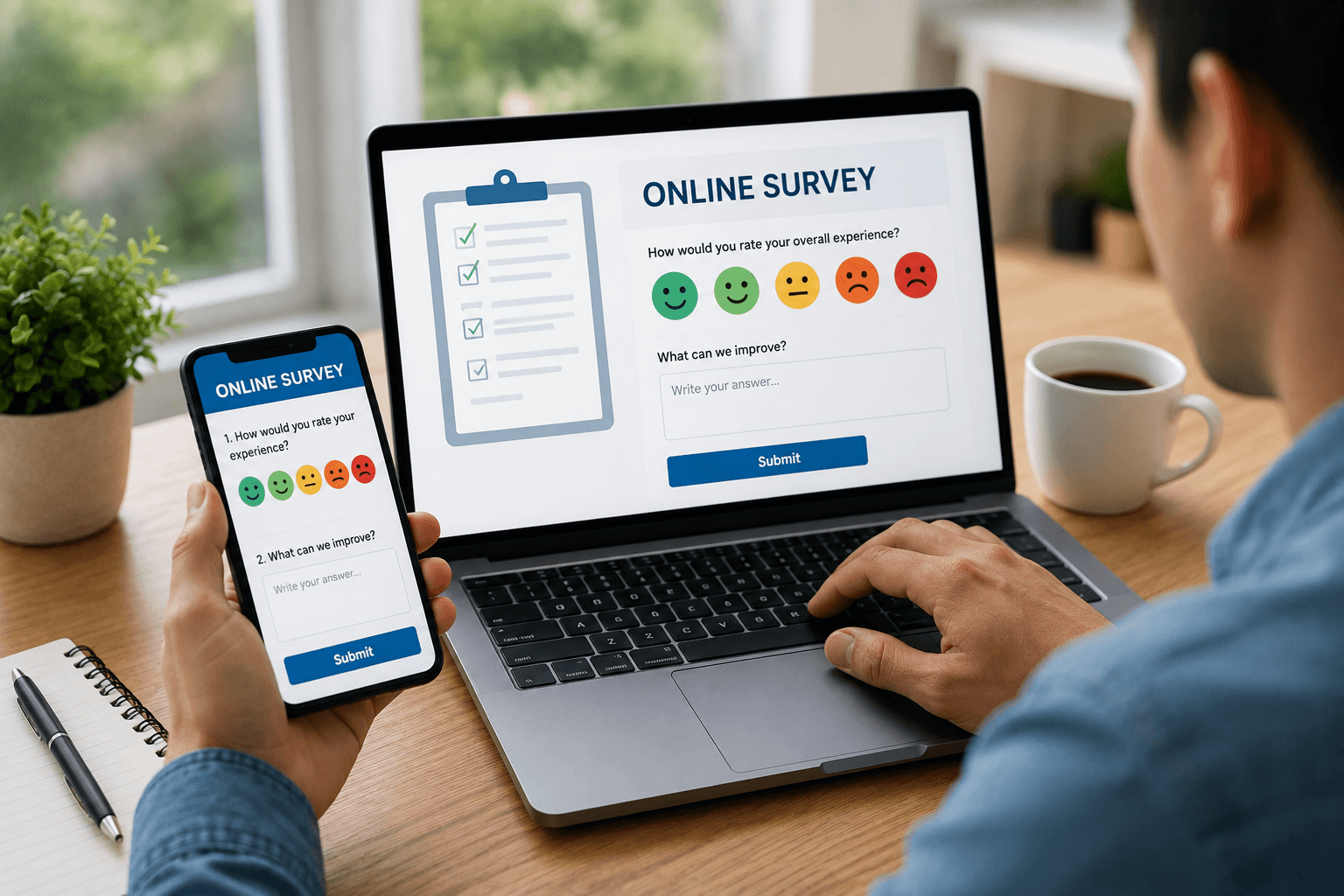
Businesses can distribute online surveys through channels such as:
- Website links
- SMS
- QR codes
- Social media
- Mobile devices
- Customer portals
Online surveys are commonly used for customer satisfaction surveys, NPS surveys, product feedback, event feedback and customer experience research.
One of the biggest advantages is that responses can be collected and organized digitally, making the information easier to analyze and report.
What Are Offline Surveys?
Offline surveys collect responses without requiring customers to complete the survey through an internet-connected platform.

Common examples include:
- Paper questionnaires
- Printed feedback forms
- In-person surveys
- Face-to-face interviews
- Feedback kiosks operating offline
- Manually recorded responses
Offline surveys can be useful when customers have limited internet access or when feedback is collected in physical environments.
For example, a business conducting research at a physical location may choose to collect responses directly from customers.
Online Surveys vs Offline Surveys: Key Differences
| Factor | Online Surveys | Offline Surveys |
| Data collection | Digital | Paper, in-person or offline |
| Internet requirement | Usually required | Not necessarily required |
| Distribution | Email, SMS, links, QR codes, websites | Physical forms or in-person |
| Data entry | Usually automated | Often manual |
| Speed | Generally faster | Can take longer |
| Cost | Often lower at scale | Printing and manual handling may add costs |
| Analytics | Easier to integrate with analytics | May require manual processing |
| Reach | Can reach geographically distributed audiences | More suitable for physical locations |
| Real-time monitoring | Often available | Usually limited |
| Customer convenience | Can complete remotely | Often requires physical participation |
Neither approach is automatically better in every situation.
The better method depends on the context in which feedback is being collected.
Advantages of Online Surveys

- Faster Feedback Collection
Online surveys can be distributed to many customers quickly.
A business can share a survey link through email, SMS, a website or QR code without physically distributing forms.
This can make online surveys useful when a company wants to collect feedback within a short period.
- Easier Data Management
With digital surveys, responses can be captured electronically.
This can reduce the need for employees to manually enter information from paper forms.
Digital responses can also make it easier to organize answers by factors such as:
- Customer segment
- Location
- Product
- Service
- Date
- Survey type
- Satisfaction level
- Easier Analytics
Online surveys can connect directly with analytics and reporting systems.
Businesses can review trends, compare responses and monitor customer experience metrics more efficiently.
This is particularly useful when customer feedback needs to be shared with different teams or management.
- Multiple Distribution Channels
Online surveys can be shared through several digital touchpoints.
For example, a business can display a QR code after a customer interaction or send a survey link after a service experience.
A platform such as piHappiness supports multiple feedback collection channels and customer experience measurement, helping businesses collect and analyze customer feedback digitally.
- Convenient for Customers
Customers can often complete an online survey when it is convenient for them.
They may respond using a smartphone, tablet or computer without needing to fill out a physical form.
Limitations of Online Surveys
Online surveys also have some limitations.
Internet Access
Customers need suitable access to the digital channel being used.
If your audience has limited connectivity or low digital accessibility, online surveys may not reach everyone effectively.
Digital Engagement
Some customers may ignore survey emails, SMS messages or links.
The success of an online survey therefore depends partly on how it is distributed and how relevant the survey experience is.
Survey Fatigue
Customers who receive too many digital surveys may become less willing to participate.
Keeping surveys short, relevant and easy to complete can help address this issue.
Advantages of Offline Surveys
- Useful in Physical Locations
Offline surveys can work well when customers are already interacting with a business in person.
Examples include:
- Retail stores
- Hospitals
- Hotels
- Restaurants
- Events
- Service centers
- Physical research locations
- Direct Customer Interaction
In-person surveys can allow researchers or employees to clarify questions when necessary.
This can be useful for more detailed research where the quality of conversation matters.
- Suitable for Some Audiences
Not every customer prefers digital communication.
Offline methods can provide an alternative for audiences who are less comfortable with online surveys.
- Useful When Internet Access Is Limited
Offline collection does not necessarily depend on continuous internet access.
This can be valuable in locations where connectivity is inconsistent.
Limitations of Offline Surveys
Manual Data Entry
Paper responses often need to be entered into a digital system before they can be analyzed.
This creates additional work and may increase the risk of data-entry errors.
Slower Reporting
Because responses may need to be collected, transported, entered and processed manually, reporting can take longer.
Physical Costs
Printed questionnaires may require paper, printing, distribution and storage.
These costs can become significant when large numbers of responses are collected.
Limited Real-Time Visibility
Unlike digital dashboards, offline surveys may not provide immediate visibility into changing customer feedback trends.
Online Surveys vs Offline Surveys: Which Is More Cost-Effective?
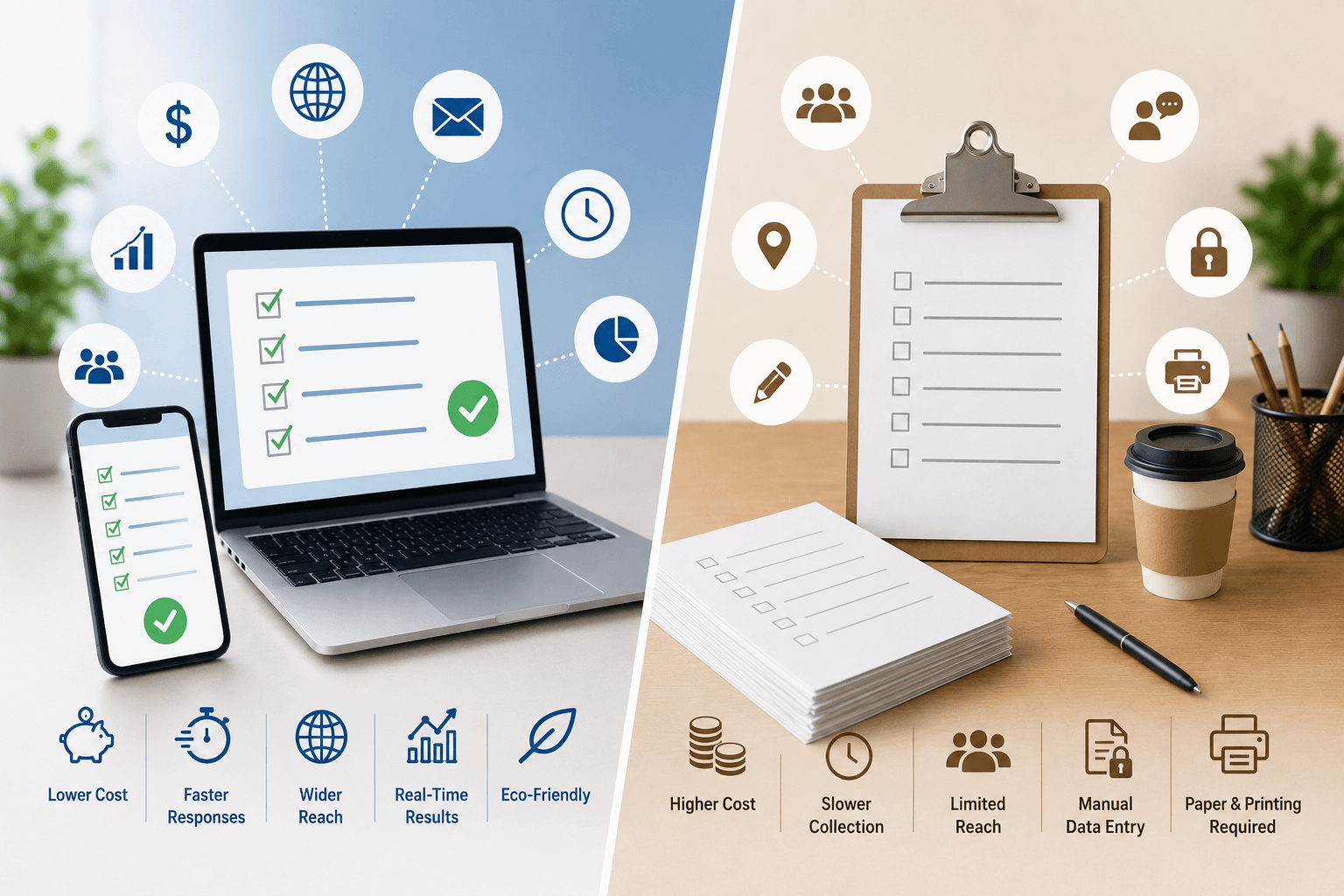
The answer depends on the scale and type of research.
For smaller physical studies, offline surveys may be practical.
For large-scale customer feedback programs, online surveys can offer advantages because digital distribution and data collection can reduce manual work.
Consider the full cost of a survey program, including:
- Survey creation
- Distribution
- Printing
- Employee time
- Data entry
- Data cleaning
- Analysis
- Reporting
- Follow-up
Looking only at the initial survey cost may not provide a complete picture.
Online Surveys vs Offline Surveys for Customer Feedback
If your goal is ongoing customer feedback, online surveys can provide several practical advantages.
Businesses can collect feedback at different stages of the customer journey.
For example:
After purchase → Product feedback
After support interaction → Service satisfaction
After an experience → Customer satisfaction
At regular intervals → Relationship feedback
The data can then be analyzed to identify recurring customer needs and pain points.
For businesses building a structured feedback strategy, understanding what customer feedback is and why it matters can help establish the foundation for effective feedback collection.
Which Survey Method Should You Choose?
Use online surveys when:
- You want to reach customers across different locations.
- You need faster data collection.
- You want digital analytics.
- You need frequent customer feedback.
- You want to distribute surveys through multiple channels.
- You want to reduce manual data entry.
Use offline surveys when:
- Customers are primarily interacting with you physically.
- Internet access is limited.
- Face-to-face interaction is important.
- Your research requires a physical environment.
- Your target audience is less comfortable with digital surveys.
In some situations, a hybrid approach can be more effective.
For example, a business could collect feedback digitally while also offering an offline option at physical locations.
Online Surveys vs Offline Surveys: Quick Comparison
| Best For | Online Surveys | Offline Surveys |
| Large audience | ✅ | ⚠️ |
| Fast collection | ✅ | ⚠️ |
| Physical locations | ⚠️ | ✅ |
| Real-time reporting | ✅ | ❌ |
| Automated data collection | ✅ | ❌ |
| Face-to-face research | ⚠️ | ✅ |
| Digital analytics | ✅ | ⚠️ |
| Limited connectivity | ⚠️ | ✅ |
| Ongoing customer feedback | ✅ | ⚠️ |
| Multi-channel feedback | ✅ | ⚠️ |
How to Make Online Surveys More Effective
Choosing an online survey platform is only one part of the process.
The survey itself should be easy for customers to complete.
Follow these practices:
Keep Questions Clear
Avoid complicated language and questions that contain multiple ideas.
Keep Surveys Short
Only ask questions that support your research objective.
Use Different Question Types
Depending on your goal, use ratings, multiple-choice questions and open-ended questions.
Make Surveys Mobile-Friendly
Many customers may access surveys through smartphones, so the experience should work well on smaller screens.
Ask for Feedback at the Right Time
Feedback collected shortly after a customer interaction can provide useful context.
Analyze Responses
Collecting feedback without analyzing it limits its value.
Businesses should look for patterns, trends and recurring issues.
How piHappiness Can Support Digital Feedback Collection
For businesses that want to move from individual surveys toward structured customer experience management, piHappiness provides tools for collecting and analyzing customer feedback.
The platform supports customer experience measurement, feedback collection, analytics, dashboards and metrics such as NPS and CSAT.
Businesses can use customer feedback to identify trends, understand customer expectations and make more informed decisions.
The important point is not simply choosing digital over offline.
It is choosing a feedback collection method that matches your customers, your business environment and your goals.
Online surveys and offline surveys both have a place in customer research.
Offline surveys can be useful for physical environments, face-to-face research and audiences with limited digital access.
Online surveys, meanwhile, can make large-scale feedback collection, digital data management and analytics easier.
For businesses looking to continuously measure customer experience, online surveys can provide a practical foundation for collecting structured customer feedback.
However, the best survey strategy is ultimately the one that makes it easy for the right customers to provide useful feedback – and gives your team the ability to turn those responses into meaningful customer insights.
With a platform such as piHappiness, businesses can bring customer feedback collection, analysis and customer experience measurement into a more structured digital workflow.
- What is the difference between online surveys and offline surveys?
Online surveys collect responses digitally through websites, email, SMS, QR codes, or online survey platforms. Offline surveys use paper forms, face-to-face interviews, or other methods that do not require an internet connection.
- Are online surveys better than offline surveys?
Not always. Online surveys are generally more convenient for large-scale digital feedback collection, while offline surveys can be useful for physical locations or audiences with limited internet access.
- What are the main advantages of online surveys?
Online surveys can offer faster distribution, easier data collection, automated reporting, digital analytics, wider reach, and convenient participation through smartphones and computers.
- What are the benefits of offline surveys?
Offline surveys can be useful for face-to-face research, physical locations, audiences with limited internet access, and situations where direct interaction with respondents is important.
- Which survey method is more cost-effective?
The cost depends on the survey size, audience, distribution method, and resources required. Online surveys can reduce printing and manual data-entry costs, particularly for large-scale feedback programs.
- Which survey method provides faster results?
Online surveys generally allow faster distribution and response collection. Digital responses can also be processed and analyzed more quickly than manually collected paper responses.
- Can online surveys be used for customer feedback?
Yes. Online surveys are commonly used to collect customer satisfaction, product feedback, service feedback, NPS, CSAT, and other customer experience data.
- When should a business use offline surveys?
Offline surveys can be useful when customers are interacting with a business in person, internet access is limited, or the research requires face-to-face participation.
- Are online surveys easier to analyze?
Generally, yes. Digital survey responses can be automatically organized and connected with analytics and reporting tools, reducing the need for manual data entry.
- Can businesses use both online and offline surveys?
Yes. A hybrid survey strategy can combine online and offline methods to reach different customer groups and collect feedback across different environments.
- How can businesses improve online survey response rates?
Keep surveys short, use simple questions, optimize them for mobile devices, choose the right distribution channel, and ask for feedback at an appropriate point in the customer journey.
- Which survey method is best for customer experience management?
For ongoing customer experience management, online surveys can provide advantages through faster feedback collection, digital analytics, centralized reporting, and easier monitoring of customer experience trends.