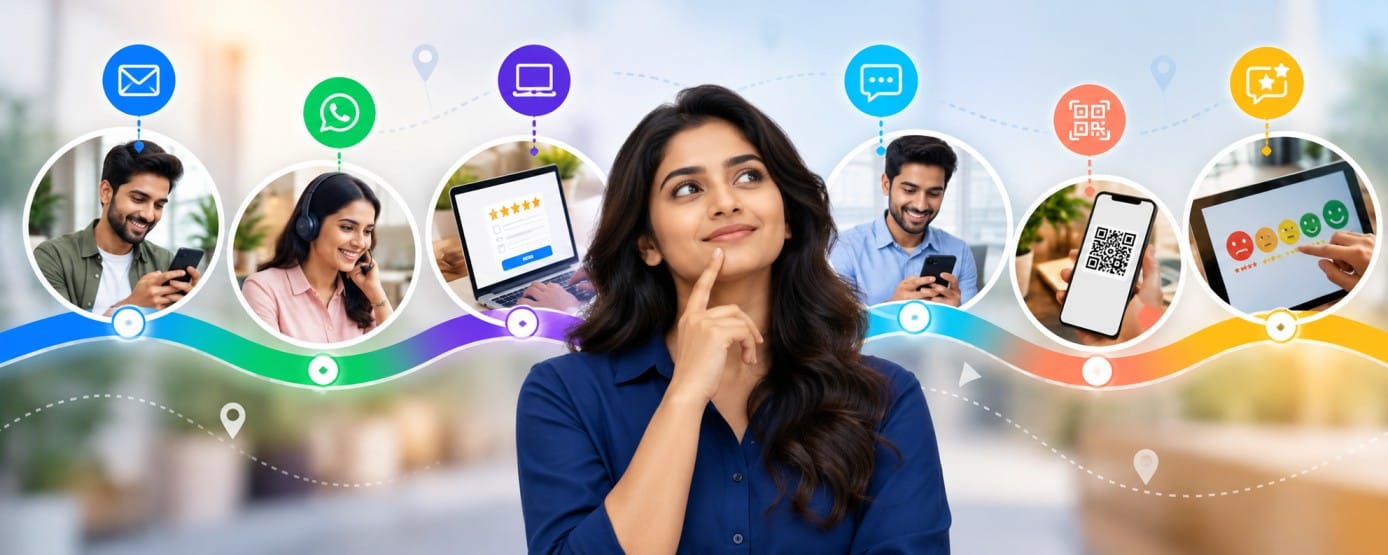
Customers interact with a business across many different touchpoints. They browse a website, speak with sales teams, make purchases, use products, contact support, visit physical locations, and eventually decide whether to return.
Each interaction creates an opportunity to understand the customer better.
However, choosing the right feedback channel is just as important as collecting feedback itself. A channel that works well after an online purchase may not work well during an in-store experience. Similarly, an email survey may be useful for detailed feedback, while an SMS survey may be better when customers need to respond quickly.
The goal is not to use every feedback channel available. The goal is to use the right channel at the right stage of the customer journey.
This guide explains how businesses can match feedback channels with customer touchpoints, improve response rates, and collect more useful customer insights.
What Is a Feedback Channel?
A feedback channel is the method a business uses to collect opinions, ratings, comments, suggestions, or complaints from customers.
Common feedback channels include:
- Email surveys
- SMS surveys
- QR code surveys
- Website feedback forms
- Mobile apps
- In-store kiosks
- Customer support conversations
- Social media
- Online reviews
- NPS surveys
- CSAT surveys
- Customer interviews
Each channel has different strengths.
For example, QR codes can make it easy for customers to provide feedback at physical locations, while email surveys can be more suitable for detailed post-purchase feedback.
The right choice depends on where the customer is, what they have just experienced, and how much effort you want them to spend providing feedback.
Why Choosing the Right Feedback Channel Matters
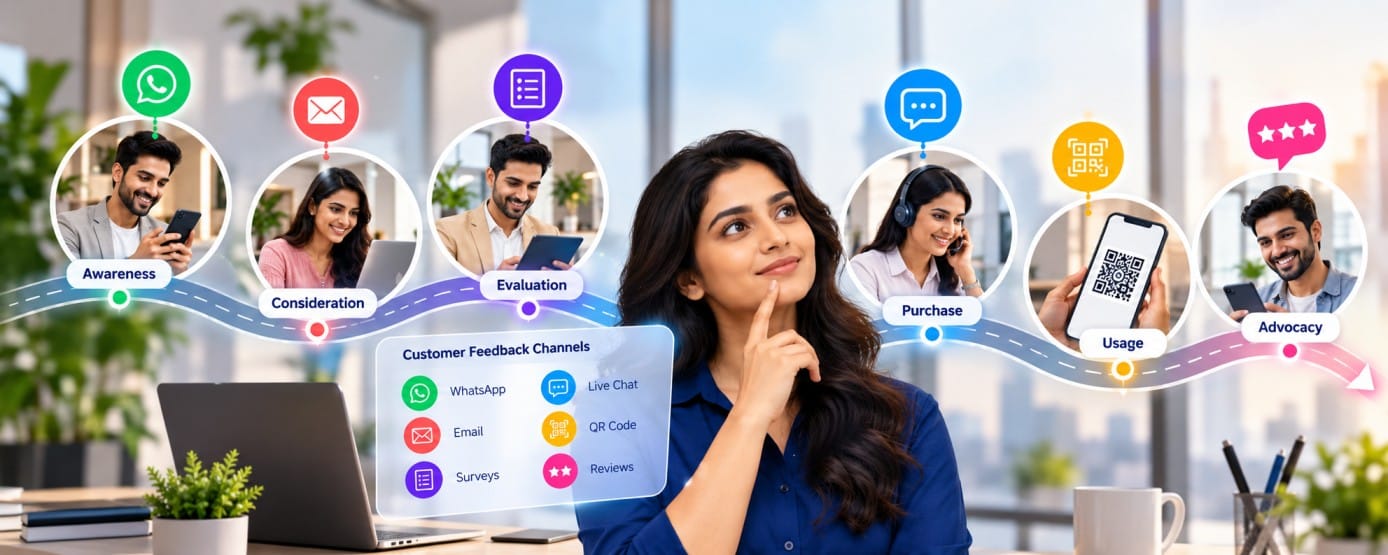
A well-designed feedback program can still produce poor results if customers are asked for feedback through an inconvenient channel.
Imagine a customer who has just completed a restaurant visit. Asking them to remember the experience several days later and complete a long email survey may not produce the same insight as asking for feedback immediately after the visit.
The same principle applies to digital experiences.
A customer who has just completed an online purchase may be comfortable receiving a short email or SMS survey. A website visitor who has not purchased anything may be more likely to respond to a simple website feedback form.
Choosing the right feedback channel can help businesses:
- Collect feedback closer to the actual experience
- Make surveys easier to complete
- Improve response opportunities
- Capture context-specific feedback
- Reduce unnecessary survey requests
- Identify customer pain points
- Understand different stages of the customer journey
The current piHappiness platform supports multiple collection methods, including SMS, email, kiosks, QR codes, websites, and tablets, allowing businesses to match collection methods with different customer situations.
Start With the Customer Journey
Before choosing a feedback channel, map the customer journey.

A simple customer journey may look like:
Awareness → Consideration → Purchase → Onboarding → Product Use → Support → Renewal → Advocacy
Customer expectations can change at every stage.
For example:
Before Purchase
Customers may interact with:
- Website pages
- Product information
- Sales representatives
- Advertising
- Social media
Useful feedback questions may focus on:
- Was the information clear?
- Did you find what you were looking for?
- What prevented you from purchasing?
During Purchase
Customers may interact with:
- Checkout
- Sales teams
- Payment systems
- Booking systems
- Store employees
Feedback can focus on:
- Ease of purchase
- Payment experience
- Staff interaction
- Checkout problems
After Purchase
Customers may interact with:
- Delivery
- Product onboarding
- Customer support
- Product usage
- Account management
Feedback can focus on:
- Satisfaction
- Product quality
- Ease of use
- Delivery experience
- Support quality
Renewal or Repeat Purchase
At this stage, businesses may want to understand:
- Loyalty
- Satisfaction
- Reasons for returning
- Reasons for leaving
- Product improvements
The channel should change with the journey instead of forcing one survey method across every touchpoint.
1. Email Surveys for Detailed Post-Purchase Feedback
Email is useful when customers have enough time and context to provide more detailed feedback.
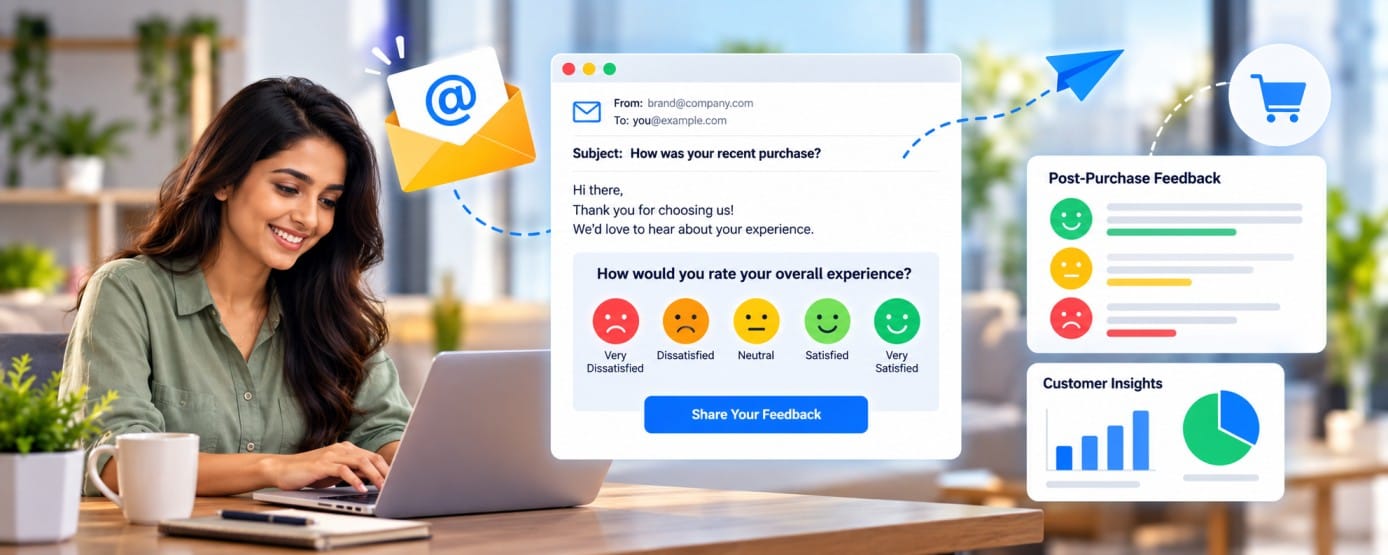
It can work particularly well for:
- Post-purchase surveys
- Customer satisfaction surveys
- Product feedback
- Service reviews
- B2B feedback
- Subscription experiences
- Detailed customer research
For example, an online retailer could send an email survey one or two days after delivery.
The survey could ask:
How satisfied were you with your purchase?
Then follow with:
What could we improve about your experience?
Email is also useful when the customer journey involves several steps and the business wants feedback on the overall experience.
piHappiness has previously covered email surveys and their use for structured customer feedback, including ways to improve their effectiveness.
However, email may not be the best option when feedback needs to be collected immediately.
2. SMS Surveys for Fast Feedback
SMS can be useful when speed and convenience are important.
Customers already use their phones throughout the day, so a short SMS survey can provide a direct way to request feedback.
SMS can work well after:
- Deliveries
- Customer support interactions
- Appointments
- Service visits
- Transactions
- Travel experiences
- Quick service interactions
For example:
How satisfied were you with today’s service?
⭐ Very satisfied
⭐ Satisfied
⭐ Neutral
⭐ Dissatisfied
⭐ Very dissatisfied
A short interaction can make it easier for customers to respond while the experience is still fresh.
PiHappiness guide to SMS surveys and their benefits explains how SMS can be used to collect quick customer feedback through a familiar communication channel.
3. QR Codes for Physical Customer Touchpoints
QR codes are particularly useful when customers are physically interacting with a business.
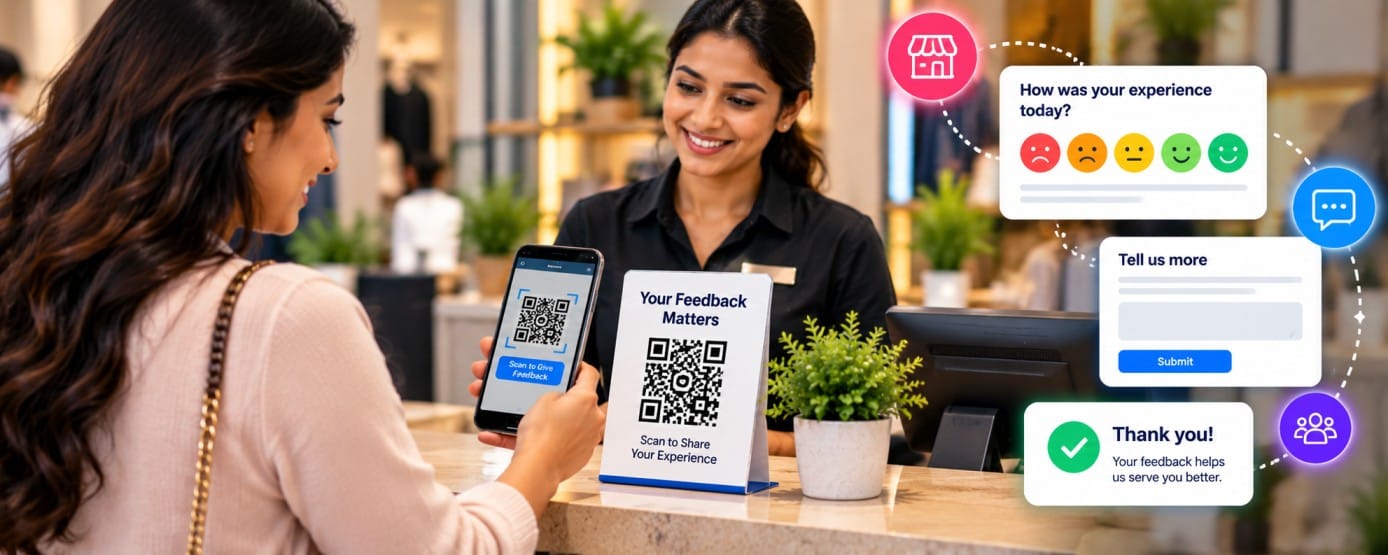
They can be placed on:
- Restaurant tables
- Bills
- Receipts
- Hotel rooms
- Retail counters
- Packaging
- Event materials
- Product displays
- Service desks
The customer scans the code using a smartphone and immediately reaches the feedback form.
This removes several steps from the feedback process.
For example, a restaurant could place a QR code on the table:
How was your dining experience today?
The customer can respond before leaving the restaurant.
QR codes are especially useful when the feedback needs to be collected at the moment of experience.
PiHappiness guide to QR code feedback explains how QR codes can make feedback collection easier at physical customer touchpoints.
4. Website Feedback for Digital Experiences
Website feedback is useful when the customer experience happens primarily online.
Businesses can use website feedback to understand:
- Navigation problems
- Content clarity
- Search difficulties
- Checkout problems
- Product information gaps
- Technical issues
- Customer questions
For example, after a customer completes a booking, a website could ask:
How easy was it to complete your booking?
This provides feedback about the digital journey while the experience is still fresh.
Website feedback can also be useful for visitors who do not complete a purchase.
A simple question such as:
Did you find what you were looking for?
can help identify gaps in website content or navigation.
5. In-Person Feedback for High-Touch Experiences
Some customer experiences are highly personal.
Examples include:
- Healthcare
- Hospitality
- Banking
- Education
- Automotive services
- Luxury retail
- Government services
In these situations, businesses may benefit from collecting feedback immediately after the interaction.
Possible channels include:
- Tablets
- Kiosks
- QR codes
- Staff-assisted surveys
For example, a hotel could ask guests for feedback during checkout.
A hospital could collect feedback after a patient interaction.
A university could collect student feedback after a course or faculty interaction.
The important factor is to keep the feedback process simple and relevant to the experience.
6. Customer Support as a Feedback Channel
Customer support conversations are one of the richest sources of customer insight.
Customers often contact support because something has gone wrong or because they need help.
Support interactions can reveal:
- Recurring problems
- Product usability issues
- Service failures
- Communication gaps
- Missing information
- Customer expectations
Businesses should therefore avoid treating support conversations only as tickets to close.
They can also be treated as feedback signals.
For example, if hundreds of customers contact support about the same feature, the issue may not be an isolated support problem. It could indicate a product or communication problem.
7. Social Media for Open Customer Sentiment
Social media can provide feedback that customers share publicly.
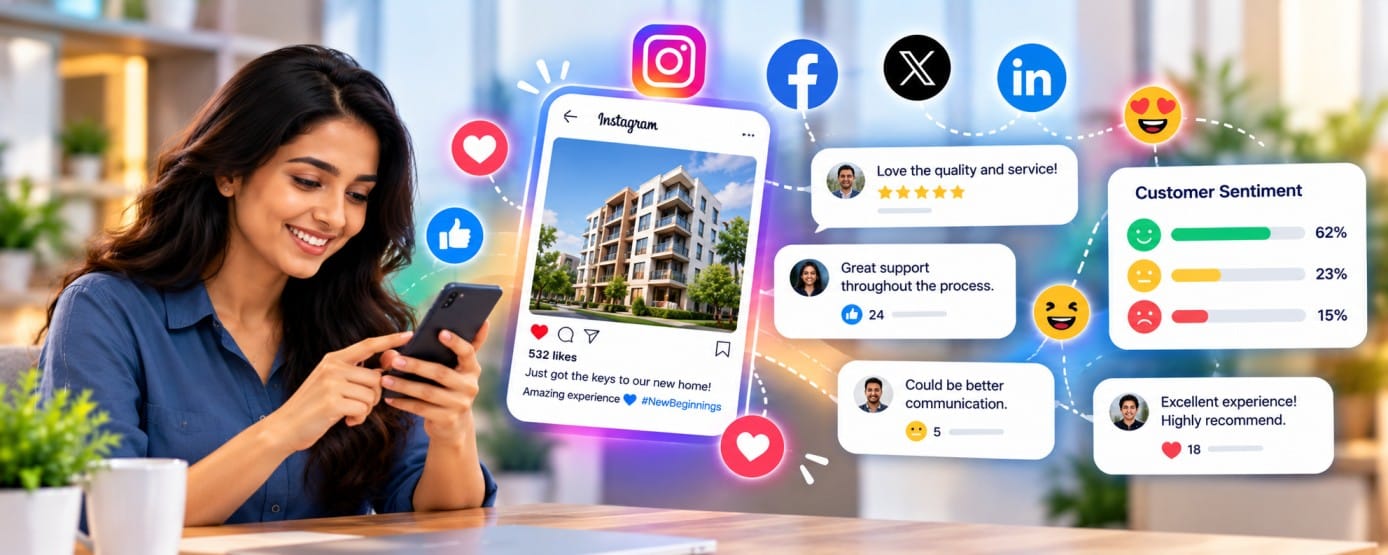
Customers may discuss:
- Products
- Services
- Brand experiences
- Complaints
- New launches
- Customer service
- Marketing campaigns
Social media is particularly useful for understanding spontaneous customer sentiment.
However, businesses should not treat social media feedback exactly like structured survey data.
A survey may ask customers a specific question, while social media comments are often unsolicited.
Using both sources can provide a broader view of customer perception.
Matching Feedback Channels to the Customer Journey
A simple framework can help businesses choose the right channel.
| Customer Journey Stage | Recommended Feedback Channels |
| Website visit | Website feedback |
| Product research | Short online survey |
| Online purchase | Email or SMS |
| Physical purchase | QR code or kiosk |
| Restaurant visit | QR code or tablet |
| Hotel stay | QR code, SMS or email |
| Customer support | Post-interaction survey |
| Product usage | In-app or email survey |
| Service appointment | SMS or QR code |
| Renewal | Email survey or NPS |
| Public brand experience | Social media monitoring |
This does not mean businesses must use every channel.
The objective is to select the channel that creates the least friction for the customer while producing useful information for the business.
One Customer Journey Can Use Multiple Channels
Choosing the right feedback channel does not mean selecting only one channel.
Customers move across channels during their journey.
For example:
Website → Purchase → Email Confirmation → Delivery → SMS Feedback → Customer Support → Follow-Up Survey
Each stage can generate different insights.
A customer may be satisfied with the product but unhappy with delivery.
Another customer may be satisfied with delivery but frustrated with support.
Using multiple channels helps businesses understand these differences.
The key is to connect the information rather than treating each response as an isolated data point.
How to Avoid Feedback Channel Overload
Using more channels does not automatically mean better feedback.
Too many requests can create survey fatigue.
Customers may become less willing to respond if they receive frequent surveys after every interaction.
To avoid this:
Keep surveys short
Ask only questions that support a clear objective.
Use frequency rules
Do not repeatedly ask the same customer for feedback within a short period.
Match timing to the experience
Ask while the experience is still relevant.
Avoid duplicate requests
If a customer has already provided feedback, consider whether another survey is necessary.
Personalize the request
Explain why you are asking for feedback when appropriate.
The goal is not to maximize the number of surveys sent.
The goal is to maximize the usefulness of the feedback collected.
How Feedback Channel Selection Improves Response Quality
Response quantity is only one part of a successful feedback program.
Response quality also matters.
A customer may give better feedback when:
- The survey arrives at the right time
- The channel is convenient
- The questions are relevant
- The survey is short
- The customer understands why feedback is being requested
For example, asking about a restaurant experience immediately after the meal may produce more context than asking the same question a month later.
Likewise, asking a customer about website usability while they are on the website can capture issues that may otherwise be forgotten.
Use the Right Channel for the Right Question
Different feedback channels can support different types of questions.
For satisfaction
Use CSAT surveys after specific interactions.
For loyalty
Use NPS surveys at appropriate relationship or lifecycle stages.
For effort
Use Customer Effort Score questions after tasks such as support or checkout.
For detailed opinions
Use email surveys or interviews.
For immediate physical experiences
Use QR codes, kiosks, or tablets.
For digital experiences
Use website or in-app feedback.
For spontaneous opinions
Monitor social media and reviews.
The question should determine the channel, not the other way around.
Create a Feedback Channel Strategy
A practical feedback channel strategy can follow five steps.
Step 1: Map the customer journey
Identify every major customer touchpoint.
Step 2: Identify feedback objectives
Decide what you want to learn at each stage.
Step 3: Select the appropriate channel
Choose the easiest and most relevant method for customers.
Step 4: Set timing and frequency rules
Avoid asking customers too often or too late.
Step 5: Connect feedback to action
Make sure the feedback reaches the teams responsible for improvement.
A strong strategy is not simply about collecting more responses.
It is about collecting more relevant responses at the right moments.
Measure Which Feedback Channels Work
Once multiple channels are in use, businesses should compare their performance.
Useful metrics include:
- Response rate
- Completion rate
- Average survey time
- Feedback volume
- Customer satisfaction score
- NPS
- Customer effort score
- Percentage of actionable responses
- Number of complaints
- Follow-up rate
For example, suppose a company uses both email and SMS after customer support interactions.
If SMS produces faster responses while email produces more detailed comments, the business can use each channel for the purpose where it performs better.
The objective is not necessarily to identify one universal winner.
It is to understand which channel works best for each customer situation.
The Role of Multichannel Feedback
Modern customer journeys rarely happen through one channel.
Customers may discover a company on social media, research its website, purchase through an app, receive an email, contact support through chat, and visit a physical location later.
Feedback collection should reflect this reality.
A multichannel approach can help businesses capture different perspectives across the customer journey.
However, the data should ideally be brought together so teams can identify patterns rather than analyzing each channel independently.
This creates a more complete view of customer experience.
Choosing the right feedback channel is about understanding customers, not simply selecting technology.
The best channel depends on the customer journey, interaction type, timing, and feedback objective.
Use QR codes when customers are physically present. Use SMS when fast responses matter. Use email when more detailed feedback is appropriate. Use website feedback for digital experiences. Use support interactions and social media to capture additional customer signals.
Most importantly, avoid treating every customer and every interaction the same way.
When businesses match feedback channels with customer journeys, they can make feedback easier to provide and more useful to analyze.
The result is a feedback program that captures customer voices at the moments when those voices matter most.
Frequently Asked Questions
- What is the best feedback channel for customers?
There is no single best feedback channel for every situation. The appropriate channel depends on the customer journey, interaction type, timing, and information the business wants to collect.
- Why is choosing the right feedback channel important?
The right channel can make feedback easier for customers to provide and can help businesses collect more relevant information at the right stage of the customer journey.
- When should businesses use SMS surveys?
SMS surveys can work well when businesses need short, convenient feedback after interactions such as deliveries, appointments, transactions, and customer support.
- When are email surveys most useful?
Email surveys are useful when customers may need more time to provide detailed feedback, such as after purchases, product experiences, or longer service journeys.
- Are QR codes good for collecting customer feedback?
Yes. QR codes can be particularly useful at physical touchpoints such as restaurants, retail stores, hotels, events, and service locations.
- Should a business use multiple feedback channels?
Multiple channels can be useful because customers interact with businesses in different ways. The important thing is to use channels based on customer needs rather than sending unnecessary surveys everywhere.
- How can businesses reduce survey fatigue?
Businesses can keep surveys short, use frequency rules, avoid duplicate requests, and send feedback requests at appropriate moments in the customer journey.
- What feedback channel is useful for website visitors?
Website feedback forms, pop-ups, or short digital surveys can help businesses understand navigation problems, content gaps, usability issues, and other aspects of the online experience.
- Can customer support be used as a feedback channel?
Yes. Support conversations can reveal recurring complaints, product problems, service issues, and unmet customer expectations.
- How should businesses choose a feedback channel?
Start by identifying the customer touchpoint, deciding what you want to learn, considering the customer’s context, and selecting the channel that makes responding easiest.
- Should feedback be collected immediately after an interaction?
In many situations, collecting feedback soon after an interaction can help capture the experience while it is still fresh. However, the ideal timing depends on the type of customer journey.
- How can businesses measure feedback channel performance?
Businesses can compare response rates, completion rates, feedback volume, customer satisfaction, NPS, customer effort, actionable responses, and other relevant metrics across channels.