
Customer complaints are easy to collect but much harder to turn into meaningful action.
A customer may report a delayed service, poor communication, billing problem, product issue, or frustrating experience. The feedback enters a survey system or inbox, but what happens next?
If nobody takes ownership, the complaint becomes just another data point.
This is where closed-loop customer feedback becomes important.
A closed-loop feedback process connects customer feedback with follow-up action. Instead of simply collecting complaints and analyzing them later, businesses identify important issues, assign ownership, respond to customers, resolve problems, and use the resulting insights to improve future experiences.
The process can be summarized simply:
Collect → Identify → Assign → Respond → Resolve → Learn → Improve
This approach helps businesses move from listening to customers to actually acting on what they hear.
In this guide, we explore what closed-loop customer feedback means, why it matters, how to manage complaints effectively, and how businesses can create a feedback process that leads to measurable improvements.
What Is Closed-Loop Customer Feedback?
Closed-loop customer feedback is a process where customer feedback is collected, reviewed, assigned to the appropriate team, acted upon, and followed through until the issue is resolved or the required action is completed.

The word “closed” is important.
A feedback loop is not complete simply because a customer submits a survey.
It is complete when the organization has taken the appropriate action based on that feedback.
For example:
Customer gives a low rating → Team receives an alert → Issue is assigned → Customer is contacted → Problem is resolved → Case is closed → Root cause is analyzed
This creates accountability.
Instead of asking only:
“What are customers saying?”
Businesses can also ask:
“What are we doing about it?”
Why Is Closed-Loop Customer Feedback Important?
Customer feedback can reveal problems that internal reports may not show.
Employees may know that a process is technically working.
Customers may know that the process is frustrating.
A customer complaint can therefore provide an important perspective on the actual customer experience.
However, collecting complaints without acting on them creates limited value.
A strong closed-loop approach helps businesses:
- Respond to customers faster
- Resolve individual complaints
- Assign clear ownership
- Identify recurring problems
- Improve customer satisfaction
- Reduce repeated complaints
- Improve operational processes
- Strengthen customer relationships
The objective is not to eliminate every complaint.
The objective is to learn from complaints and respond effectively when problems occur.
The Difference Between Open-Loop and Closed-Loop Feedback
Understanding the difference helps explain why the process matters.
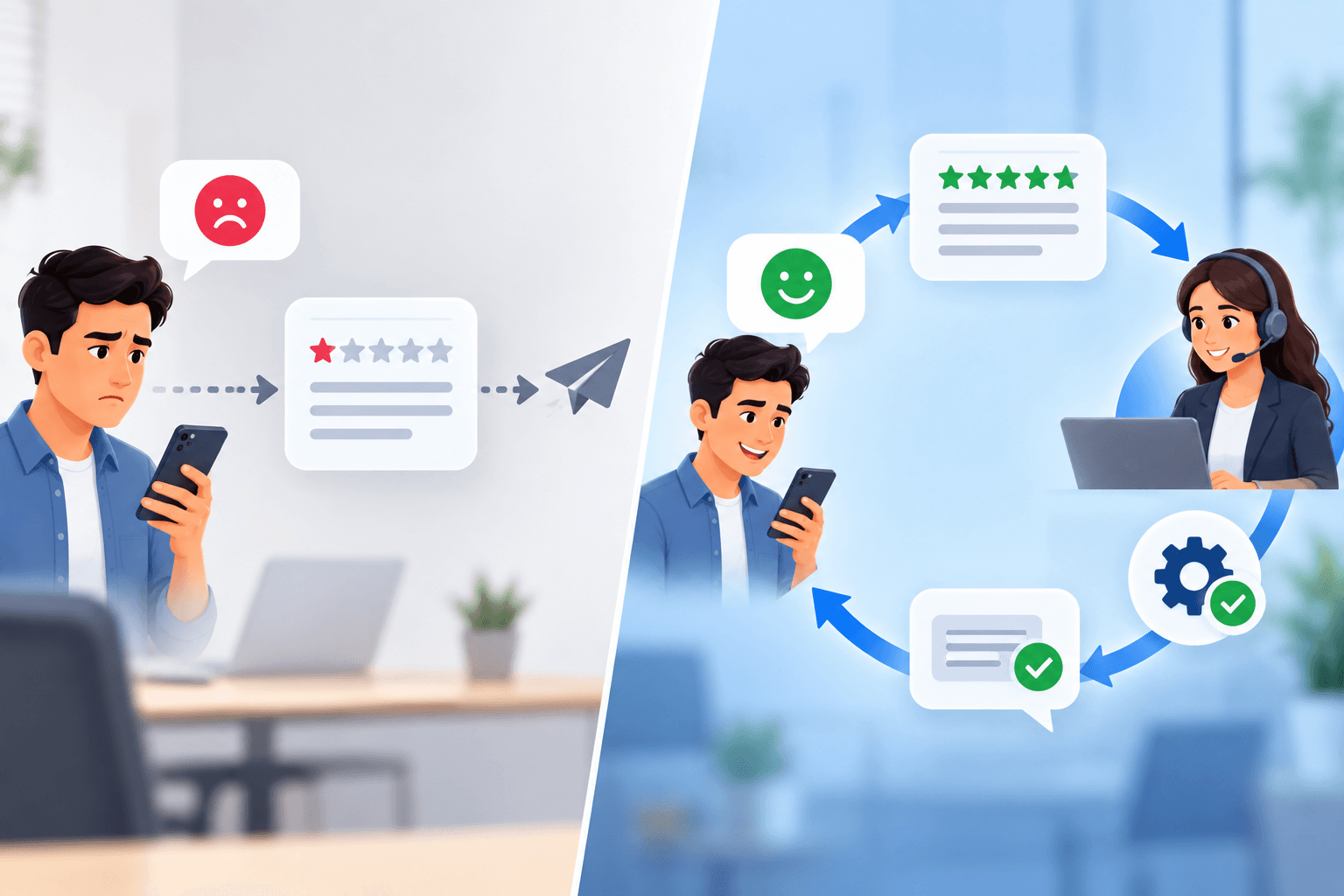
Open-Loop Feedback
The customer provides feedback.
The business collects it.
The response is stored.
A report may be generated.
But no specific action follows.
Customer → Feedback → Database
Closed-Loop Feedback
The customer provides feedback.
The issue is identified.
The responsible person is notified.
The issue is investigated.
The customer receives appropriate follow-up.
The problem is resolved or escalated.
The organization learns from the issue.
Customer → Feedback → Alert → Assign → Act → Resolve → Learn
The second process creates a stronger connection between customer insight and business action.
How Closed-Loop Customer Feedback Turns Complaints Into Action

- Collect the Feedback
The first step is capturing customer feedback through relevant channels.
Businesses may collect feedback through:
- Surveys
- CSAT
- NPS
- QR codes
- SMS
- Websites
- Mobile applications
- Customer support
- Reviews
- In-person interactions
Different channels capture different parts of the customer journey.
For example, a QR code may be useful at a physical location, while an email survey may work better after an online transaction.
The goal is to make it easy for customers to share their experience.
For more information about different collection methods, see piHappiness Customer Feedback Methods: 15 Ways to Collect Better Insights.
- Identify Feedback That Requires Action
Not every feedback response requires an immediate follow-up.
A five-star rating with no comment may simply need to be recorded.
A serious complaint may require immediate attention.
Businesses should therefore establish clear rules for identifying actionable feedback.
Examples include:
- Very low satisfaction scores
- Serious complaints
- Negative comments
- Unresolved service issues
- Repeated complaints
- Escalation requests
- Specific operational problems
This prevents teams from treating every feedback response in exactly the same way.
- Alert the Right Person
Once actionable feedback is identified, it needs to reach someone who can do something about it.
This is where automated notifications can help.
For example:
Low CSAT → Customer service manager
Product complaint → Product team
Location complaint → Branch manager
Billing issue → Finance or support team
The important principle is:
Feedback needs an owner.
Without ownership, even an excellent customer feedback system can become a storage facility for unresolved complaints.
- Assign the Complaint
An alert alone does not guarantee action.
The issue should be assigned to a specific person or team.
This creates accountability.
A case management workflow can track information such as:
- Complaint category
- Customer feedback
- Assigned employee
- Priority
- Status
- Follow-up activity
- Resolution
- Closure date
This makes it easier for managers to understand what is happening with customer issues.
- Respond to the Customer
Once the complaint is assigned, the next step is customer communication when appropriate.
The response should acknowledge the customer’s concern and explain what will happen next.
The exact response depends on the situation.
A simple complaint may require clarification.
A serious service failure may require escalation.
A complex issue may require investigation before the customer receives a final answer.
The important thing is that the customer should not feel that their feedback disappeared into a system.
- Resolve the Immediate Problem
Service recovery focuses on addressing the customer’s immediate concern.
For example:
A customer reports a delayed delivery.
The business investigates the order.
The delivery issue is corrected.
The customer receives an update.
The complaint is closed.
This resolves the immediate problem.
But closed-loop feedback should go one step further.
The organization should ask:
Why did the problem happen?
- Identify the Root Cause
One complaint may be an isolated incident.
Repeated complaints usually deserve deeper investigation.
Suppose customers repeatedly complain about:
- Long waiting times
- Confusing billing
- Slow support
- Difficult booking
- Poor communication
- Product availability
The organization should look beyond individual cases.
Root-cause analysis can help identify whether the problem comes from:
- Processes
- Technology
- Training
- Staffing
- Communication
- Product design
- Policies
- Operational capacity
This is where customer feedback becomes a source of continuous improvement.
- Close the Case
A complaint should have a clear status.
For example:
New → Assigned → In Progress → Resolved → Closed
This creates visibility for both employees and managers.
A case should not be considered closed simply because someone has responded.
The business should determine whether the required action has actually been completed.
Depending on the issue, closure may include:
- Customer contacted
- Problem resolved
- Compensation provided where appropriate
- Internal correction completed
- Root cause recorded
- Follow-up completed
- Learn From the Complaint
The final stage is learning.
A single complaint may help resolve one customer’s problem.
A collection of similar complaints can reveal a business-wide opportunity.
This is why businesses should analyze feedback for recurring patterns.
Look for trends across:
- Locations
- Products
- Services
- Customer segments
- Employees or teams
- Feedback channels
- Time periods
- Complaint categories
This transforms individual complaints into organizational insight.
The Closed-Loop Customer Feedback Process
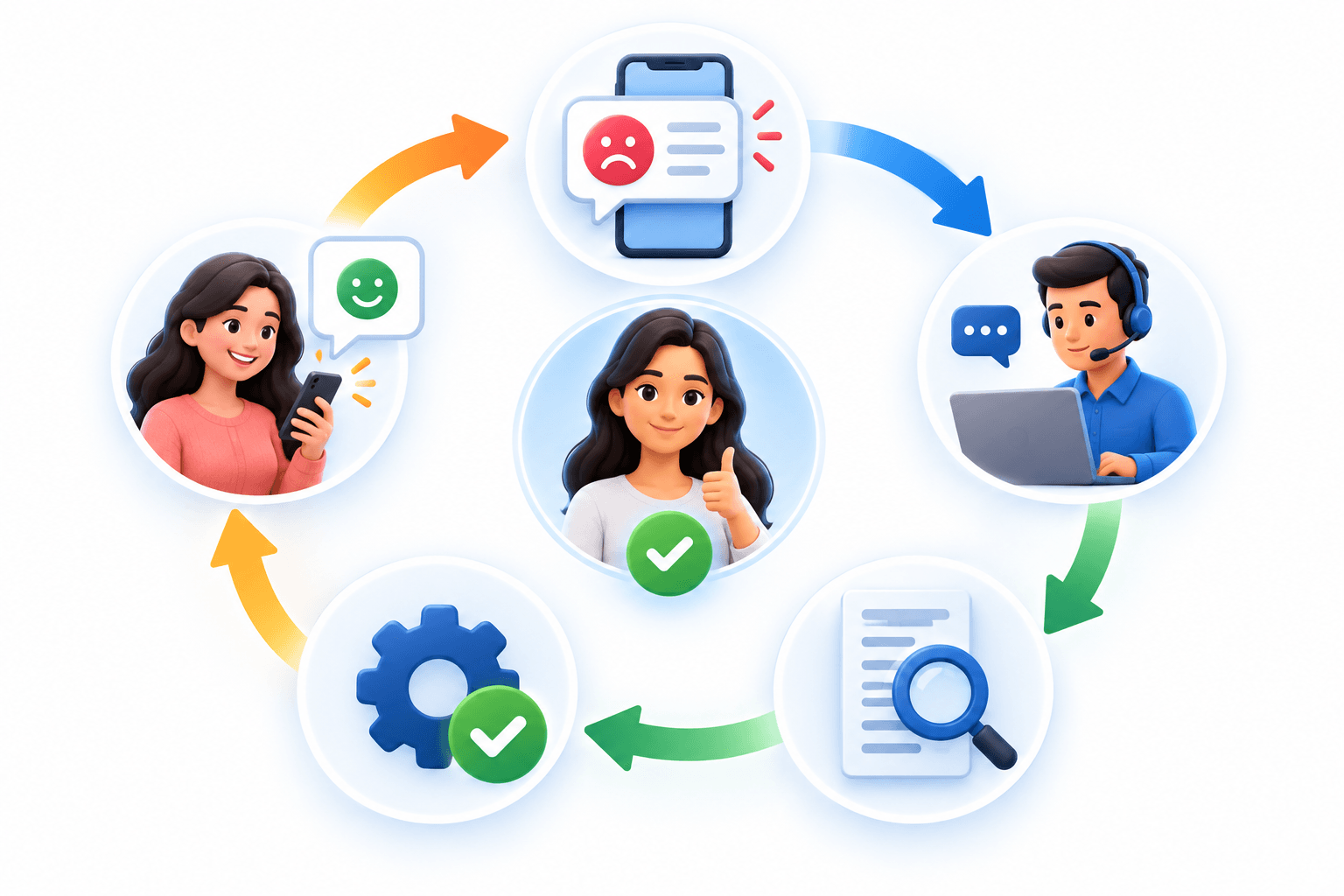
A practical closed-loop process can be represented as:
Step 1: Collect
Capture customer feedback.
Step 2: Detect
Identify feedback that requires attention.
Step 3: Alert
Notify the responsible team.
Step 4: Assign
Give the issue a clear owner.
Step 5: Respond
Communicate with the customer when appropriate.
Step 6: Resolve
Address the customer’s immediate concern.
Step 7: Analyze
Identify patterns and root causes.
Step 8: Improve
Change the process, product, or service where necessary.
Step 9: Measure
Monitor whether the improvement actually worked.
This creates a continuous cycle rather than a one-time activity.
How CSAT Can Support Closed-Loop Feedback
Customer Satisfaction Score, or CSAT, can help businesses identify customers who may require follow-up.
For example:
CSAT score: 2/5
Comment: “The issue was not resolved after contacting support.”
This response provides both a measurable satisfaction score and a potential reason for dissatisfaction.
A business could trigger an alert, assign the case to the support manager, investigate the issue, and follow up with the customer.
To learn more about CSAT, see What Is CSAT and How Is It Calculated?.
CSAT should not be viewed only as a score.
When connected to a closed-loop process, it can become an operational signal.
Real-Time Alerts Make Closed-Loop Feedback Faster
Speed can have a major impact on service recovery.
If a serious complaint sits unnoticed for several days, the opportunity to influence the customer’s experience may decrease.
Real-time alerts can help shorten the gap between feedback and action.
For example:
Customer submits complaint
↓
System identifies critical feedback
↓
Responsible manager receives alert
↓
Case is assigned
↓
Customer is contacted
↓
Issue is resolved
This creates a faster feedback-to-action process.
The goal is not necessarily to respond instantly to every customer.
It is to make sure important feedback does not remain unnoticed.
How Closed-Loop Feedback Improves Customer Experience
Customer experience is shaped by many individual interactions.
One poor interaction does not always result in customer loss.
How the business responds can influence the outcome.
Imagine a customer has a poor experience.
The business ignores it.
The customer feels unheard.
Now consider another situation.
The customer reports the issue.
The business responds.
The problem is investigated.
The customer receives appropriate follow-up.
The organization improves the underlying process.
The second experience demonstrates that the business is listening and willing to act.
This is why closed-loop customer feedback can contribute to stronger customer experience management.
Common Mistakes in Customer Feedback Loops
Even businesses with feedback programs can struggle to close the loop.
Collecting Feedback Without Ownership
If nobody owns the next action, complaints can remain unresolved.
Treating Every Complaint the Same
Different issues have different levels of urgency.
Responding Without Fixing the Root Cause
A customer may receive an apology while the underlying problem continues.
Focusing Only on Individual Complaints
Recurring issues should be analyzed across the business.
Closing Cases Too Quickly
A response does not always mean resolution.
Measuring Feedback Without Measuring Action
Businesses should track not only what customers say but also what teams do about it.
How to Build an Effective Closed-Loop Feedback Strategy
Businesses can start with a simple framework.
- Define What Requires Follow-Up
Set clear rules for complaints, low scores, and other actionable feedback.
- Create Ownership
Assign each feedback category to an appropriate department or team.
- Establish Response Priorities
Determine which issues require immediate attention and which can follow a standard workflow.
- Use Case Management
Track complaints from initial submission through resolution.
- Automate Important Notifications
Use alerts to ensure critical feedback reaches the right people quickly.
- Measure Resolution
Track metrics such as:
- Response time
- Resolution time
- Open cases
- Closed cases
- Repeat complaints
- Escalation rate
- Customer satisfaction after resolution
- Analyze Recurring Problems
Look for patterns instead of treating every complaint as an isolated event.
- Feed Insights Back Into Operations
Use customer feedback to improve products, processes, training, and service delivery.
Measuring the Success of Closed-Loop Customer Feedback
A successful feedback loop should be measurable.
Important metrics can include:
| Metric | What It Shows |
| Response Time | How quickly teams react |
| Resolution Time | How long issues take to resolve |
| Resolution Rate | Percentage of cases successfully resolved |
| Repeat Complaints | Whether the same problems continue |
| Escalation Rate | How often issues require higher-level attention |
| CSAT After Resolution | Customer satisfaction following service recovery |
| Open Cases | Current unresolved workload |
These metrics help businesses understand whether feedback is actually being converted into action.
The goal is not to achieve perfect numbers overnight.
The goal is to identify where the process is working and where it needs improvement.
Closed-Loop Feedback and Voice of Customer
Closed-loop feedback can also become an important part of a broader Voice of Customer strategy.
Voice of Customer programs help businesses understand what customers need, expect, experience, and value.
Closed-loop feedback adds an important operational layer:
What should we do about what customers are telling us?
This creates a connection between customer insight and business improvement.
For a broader look at building this strategy, see How to Build a Voice of Customer Strategy.
Turning Complaints Into Business Improvement
A complaint should not automatically be viewed as a failure.
It can also be a source of information.
Consider this example:
Complaint: Customers are waiting too long for support.
Pattern: Similar complaints appear across multiple weeks.
Root cause: Support volume has increased without additional capacity.
Action: Staffing and workflow are reviewed.
Measurement: Response times are tracked after the change.
Result: Waiting time decreases.
This is the real value of closed-loop customer feedback.
The original complaint helps solve an individual problem.
The pattern helps improve the wider customer experience.
Customer feedback becomes valuable when businesses act on it.
Collecting complaints is not enough.
Analyzing them is not enough.
Sending an automated alert is not enough.
A complete feedback process needs ownership, action, resolution, and learning.
Closed-loop customer feedback creates that connection.
The process is simple:
Collect → Detect → Assign → Respond → Resolve → Learn → Improve
When businesses consistently follow this process, customer complaints can become more than individual service issues.
They can become signals that help identify operational problems, improve customer satisfaction, strengthen service recovery, and create better customer experiences.
The ultimate goal is not to eliminate every complaint.
It is to make sure every meaningful complaint has the opportunity to create action and improvement.
A customer who takes the time to provide feedback is giving the business valuable information.
The best businesses do not simply listen.
They close the loop.
Frequently Asked Questions
- What is closed-loop customer feedback?
Closed-loop customer feedback is a process where businesses collect customer feedback, identify issues, assign them to the appropriate team, take action, resolve the problem, and use the insights to improve future customer experiences.
- Why is closed-loop customer feedback important?
Closed-loop customer feedback helps businesses turn customer opinions and complaints into action. It creates accountability, supports faster service recovery, improves issue resolution, and helps organizations identify recurring problems.
- What is the difference between open-loop and closed-loop feedback?
Open-loop feedback is collected but may not lead to a specific action. Closed-loop feedback connects customer responses with ownership, follow-up, resolution, and continuous improvement.
- How does closed-loop feedback help manage customer complaints?
It provides a structured process for identifying complaints, notifying the appropriate team, assigning responsibility, responding to the customer, resolving the issue, and analyzing the root cause.
- How quickly should businesses respond to customer complaints?
Response time should depend on the severity of the complaint. Serious issues should receive prompt attention, while less urgent feedback can follow a defined workflow. Businesses should establish clear response priorities.
- What role does CSAT play in closed-loop customer feedback?
CSAT can help identify dissatisfied customers who may require follow-up. Low satisfaction scores can be connected to alerts or case-management workflows so teams can investigate and address the underlying issue.
- Can closed-loop feedback improve customer satisfaction?
Yes. When businesses respond to complaints, resolve issues, and improve recurring problems, they can create better customer experiences. Measuring satisfaction after service recovery can also help determine whether actions were effective.
- What types of customer feedback should be included in a closed-loop process?
Businesses can include low CSAT scores, serious complaints, negative comments, service failures, unresolved issues, escalation requests, and recurring customer problems. The exact criteria should match the organization’s priorities.
- How do real-time alerts support closed-loop feedback?
Real-time alerts can notify the appropriate team when important feedback is received. This reduces the time between a customer reporting a problem and the business beginning the response process.
- How can businesses measure the success of a closed-loop feedback program?
Businesses can track response time, resolution time, resolution rate, open cases, repeat complaints, escalation rate, and customer satisfaction after resolution. These metrics show whether feedback is being converted into action.
- How does closed-loop feedback support Voice of Customer programs?
Voice of Customer programs help businesses understand customer needs and expectations, while closed-loop feedback helps turn those insights into action. Together, they connect customer understanding with operational improvement.
- How can businesses start a closed-loop customer feedback process?
Businesses can start by defining which feedback requires action, assigning clear ownership, creating response workflows, using case management, setting up alerts for important issues, tracking resolution, and analyzing recurring complaints for continuous improvement.