
Customer satisfaction is one of the clearest indicators of how customers feel about a product, service, interaction, or overall experience. While businesses can collect thousands of customer comments, they also need a simple way to measure satisfaction and track changes over time.
This is where CSAT, or Customer Satisfaction Score, becomes useful. If you’re wondering what is CSAT and how is it calculated, it is a metric that helps businesses measure how satisfied customers are with a specific interaction, product, service, or overall experience.
CSAT is commonly used after a purchase, customer support interaction, service experience, product use, or other important customer touchpoint.
But what is CSAT and how is it calculated? What is considered a good CSAT score? And how can businesses use CSAT feedback to improve customer experience?
Let’s explore everything you need to know.
Quick Summary
- CSAT stands for Customer Satisfaction Score.
- It measures how satisfied customers are with a specific experience or interaction.
- Customers are usually asked to rate their satisfaction using a numerical or visual scale.
- The CSAT percentage is calculated by dividing satisfied responses by total responses and multiplying by 100.
- CSAT is useful for measuring satisfaction at specific customer touchpoints.
- A high CSAT score generally indicates stronger customer satisfaction.
- CSAT should be analyzed together with customer comments and other CX metrics.
- Businesses can use CSAT insights to identify problems and improve customer experience.
What Is CSAT?
CSAT, or Customer Satisfaction Score, is a customer experience metric used to measure how satisfied customers are with a specific interaction, product, service, or experience.

A typical CSAT survey asks customers a question such as:
“How satisfied were you with your experience?”
Customers then select an answer using a rating scale.
For example, a business might use a 1–5 scale:
| Rating | Response |
| 1 | Very Dissatisfied |
| 2 | Dissatisfied |
| 3 | Neutral |
| 4 | Satisfied |
| 5 | Very Satisfied |
The business can then calculate the percentage of respondents who selected the positive satisfaction options.
CSAT is particularly useful because it focuses on a specific customer experience rather than attempting to measure every aspect of the customer relationship at once.
For a broader understanding of how customer feedback contributes to customer experience, see the piHappiness guide on What Is Customer Feedback?.
What Does CSAT Measure?
CSAT measures customer satisfaction at a particular point in the customer journey.

For example, a company might measure CSAT after:
- A customer support interaction
- A product purchase
- A service appointment
- A delivery
- A product return
- A website interaction
- A technical support request
- An onboarding experience
- A specific customer service interaction
This makes CSAT especially useful for identifying which parts of the customer journey are performing well and which require improvement.
For example, a business may have high overall customer satisfaction but lower satisfaction after customer support interactions.
Without measuring satisfaction at individual touchpoints, this issue could be difficult to identify.
How Is CSAT Calculated?
The basic CSAT formula is:
CSAT = (Number of satisfied responses ÷ Total number of responses) × 100
Let’s look at a simple example.
Suppose 200 customers respond to a CSAT survey.
Out of those:
- 150 customers select a satisfied response
- 50 customers select a neutral or dissatisfied response
The calculation would be:
CSAT = (150 ÷ 200) × 100
CSAT = 75%
Therefore, the CSAT score would be 75%.
The exact calculation can vary depending on the rating scale and which responses the organization defines as “satisfied.”
The important point is to establish the scoring methodology consistently so that results can be compared meaningfully over time.
How Does a 5-Point CSAT Scale Work?
A 5-point scale is commonly used for customer satisfaction surveys.
For example:
| Score | Satisfaction Level |
| 1 | Very Dissatisfied |
| 2 | Dissatisfied |
| 3 | Neutral |
| 4 | Satisfied |
| 5 | Very Satisfied |
If the business defines scores 4 and 5 as satisfied, those responses are used when calculating the CSAT percentage.
For example, if 100 customers respond:
- 10 choose 1
- 15 choose 2
- 15 choose 3
- 25 choose 4
- 35 choose 5
Satisfied responses = 25 + 35 = 60
CSAT = (60 ÷ 100) × 100
CSAT = 60%
The organization can then track whether that percentage changes over time.
How Does a 10-Point CSAT Scale Work?
Some organizations use a 10-point satisfaction scale instead of a 5-point scale.
For example:
1 = Very Dissatisfied
10 = Very Satisfied
The business needs to define which scores qualify as satisfied before calculating CSAT.
For example, an organization might choose a predetermined positive-response range.
The key is consistency.
If one month uses one definition of “satisfied” and another month uses a different definition, comparing the results can become misleading.
What Is a Good CSAT Score?
There is no universal CSAT score that can automatically be described as “good” for every business.
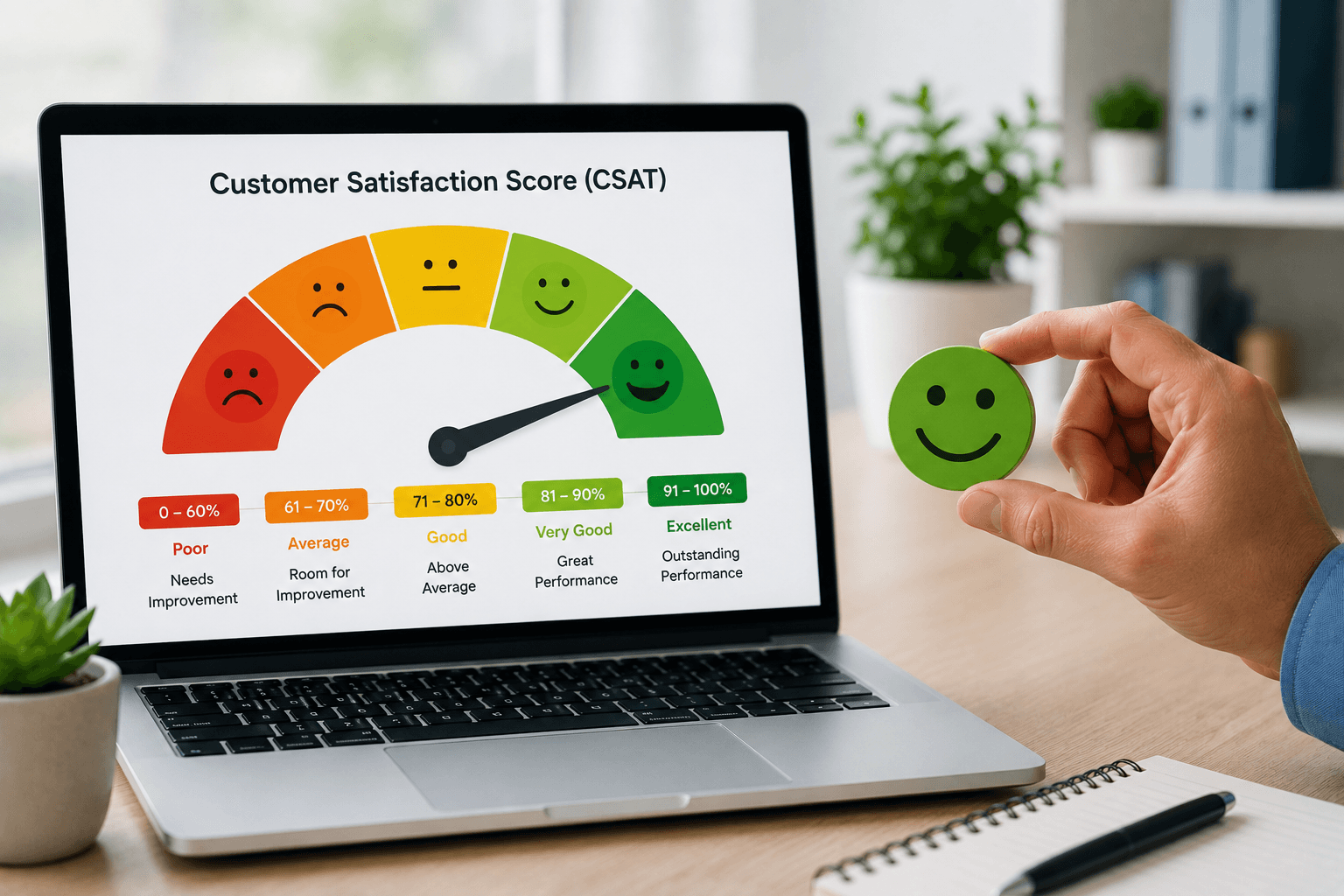
CSAT can vary by:
- Industry
- Customer segment
- Product
- Service
- Customer journey stage
- Survey design
- Rating scale
- Customer expectations
- Market
Instead of focusing only on an external benchmark, businesses should also track their own CSAT trends.
For example:
Month 1: 72%
Month 2: 76%
Month 3: 81%
This upward trend may be more useful to the organization than simply comparing its score with a generic benchmark.
Businesses should also investigate why the score changes.
A higher CSAT score is useful, but understanding the factors behind the result is even more valuable.
Why Is CSAT Important?
CSAT can help businesses understand customer satisfaction at important points in the customer journey.
- Identifies Customer Pain Points
A low CSAT score can indicate that customers are experiencing problems with a particular product, service, process, or interaction.
- Measures Specific Experiences
Unlike some broader customer experience metrics, CSAT can be tied to a specific interaction.
For example:
“How satisfied were you with the support you received today?”
This makes the feedback easier to connect with a particular business process.
- Helps Teams Track Improvements
Businesses can measure CSAT before and after making changes to a customer-facing process.
This can help teams understand whether the experience is improving.
- Supports Customer Experience Decisions
CSAT results can help customer experience teams identify areas that require attention.
When combined with qualitative feedback, the metric can provide additional context around customer needs and expectations.
For more information about analyzing feedback, see the piHappiness resource on Customer Feedback Analysis.
CSAT vs NPS: What’s the Difference?
CSAT and NPS are both customer experience metrics, but they measure different aspects of the customer relationship.
| Feature | CSAT | NPS |
| Full form | Customer Satisfaction Score | Net Promoter Score |
| Primary focus | Satisfaction | Loyalty / recommendation |
| Typical use | Specific interaction | Broader relationship |
| Question type | Satisfaction question | Likelihood to recommend |
| Best suited for | Touchpoint measurement | Relationship measurement |
CSAT can answer:
“How satisfied were you with this experience?”
NPS can answer:
“How likely are you to recommend the company?”
Neither metric necessarily replaces the other.
Businesses can use both to develop a broader understanding of customer experience.
The piHappiness article NPS vs. CSAT: Which Customer Experience Metric Is Best? provides a more detailed comparison of the two metrics.
CSAT vs CES
Another customer experience metric businesses may use is Customer Effort Score (CES).
While CSAT focuses on satisfaction, CES focuses on how easy or difficult it was for a customer to complete an interaction.
For example:
CSAT:
“How satisfied were you with your support experience?”
CES:
“How easy was it to get your issue resolved?”
These metrics can provide different perspectives.
A customer might successfully resolve an issue but still feel that the process required too much effort.
Combining satisfaction and effort feedback can therefore provide additional context.
How to Create an Effective CSAT Survey
A useful CSAT survey should be simple and relevant to the experience being measured.
Keep the Main Question Clear
For example:
“How satisfied were you with your experience?”
Avoid unnecessarily complicated questions.
Ask at the Right Time
Send the survey close to the interaction you want to measure.
For example, a customer support CSAT survey can be triggered after an interaction is completed.
Use a Consistent Scale
Keep the rating scale consistent when comparing results over time.
Include an Optional Comment
A numerical score tells you how satisfied the customer was.
An open-ended question can help explain why.
For example:
“What could we have done better?”
This additional feedback can be extremely useful when analyzing low CSAT scores.
How to Use CSAT Feedback for Improvement
A CSAT score should not be treated as the final result.
The real value comes from understanding what is driving the score.
A simple process is:
Collect → Measure → Analyze → Act → Re-measure
Collect
Gather customer satisfaction feedback after relevant interactions.
Measure
Calculate CSAT using a consistent methodology.
Analyze
Look for trends, recurring problems and differences between customer groups.
Act
Identify specific areas that require improvement.
Re-measure
Collect feedback again to understand whether the customer experience has changed.
This turns CSAT from a reporting metric into a continuous improvement tool.
Common CSAT Measurement Mistakes
- Looking Only at the Overall Score
An overall CSAT score can hide problems within specific customer segments or touchpoints.
Analyze the score at useful levels where enough data is available.
- Ignoring Customer Comments
A score alone does not explain the reason behind customer satisfaction or dissatisfaction.
Use comments to add context.
- Changing the Calculation Method
Changing the definition of a satisfied response can make historical comparisons difficult.
Document the methodology and keep it consistent.
- Measuring Too Infrequently
Customer satisfaction can change as products, services and processes change.
Regular measurement can help identify trends earlier.
- Treating CSAT as the Only CX Metric
CSAT is useful, but it should be considered alongside other relevant customer experience measurements.
How piHappiness Can Help With CSAT
Managing customer satisfaction becomes easier when feedback collection, measurement and analysis are connected.
piHappiness provides customer experience and feedback capabilities that can help organizations collect customer responses, measure satisfaction and analyze customer feedback. Businesses can use these capabilities to understand what is CSAT and how is it calculated while tracking customer satisfaction more effectively.
The platform supports customer experience measurement, surveys, dashboards and analytics, helping businesses turn customer responses into more useful insights and make informed decisions to improve customer experiences.
For organizations looking to structure their customer experience measurement process, explore the piHappiness Customer Experience platform.
The goal is not simply to calculate a CSAT percentage.
The goal is to understand what that percentage is telling you and use the insight to improve the customer experience.
Best Practices for Measuring CSAT
Follow these practices to make CSAT more useful:
- Define what a satisfied response means.
- Keep the calculation methodology consistent.
- Ask the survey at a relevant customer touchpoint.
- Keep the survey short and easy to complete.
- Track CSAT trends over time.
- Segment results where meaningful.
- Analyze customer comments alongside scores.
- Identify recurring causes of dissatisfaction.
- Share insights with the teams responsible for improvement.
- Re-measure after changes are implemented.
CSAT Calculation Checklist
Before reporting your CSAT score, check:
☑ Is the survey question clear?
☑ Is the rating scale consistent?
☑ Have you defined which responses count as satisfied?
☑ Is the total response count accurate?
☑ Is the calculation method documented?
☑ Are you tracking the score over time?
☑ Have you reviewed customer comments?
☑ Have you identified the main reasons behind the score?
☑ Are the findings connected to an action plan?
CSAT is a simple but useful customer experience metric for measuring satisfaction at specific customer touchpoints.
The basic calculation is straightforward:
CSAT = (Satisfied Responses ÷ Total Responses) × 100
However, the real value of CSAT goes beyond the percentage.
Businesses need to understand what is influencing customer satisfaction, which areas require improvement and whether actions are making a measurable difference.
When CSAT scores are combined with customer comments, feedback analysis and other relevant CX metrics, organizations can develop a clearer understanding of the customer experience.
With a structured platform such as piHappiness, businesses can bring customer feedback, surveys, analytics and customer experience measurement together to turn satisfaction data into actionable insights.
Measure satisfaction. Understand the reason. Improve the experience.
Frequently Asked Questions (FAQs)
1. What does CSAT stand for?
CSAT stands for Customer Satisfaction Score. It measures how satisfied customers are with a specific product, service, interaction or experience.
2. How is CSAT calculated?
The basic formula is (Number of satisfied responses ÷ Total number of responses) × 100.
3. What is a good CSAT score?
There is no universal score that is considered good for every organization. Businesses should consider their industry, survey methodology and, importantly, their own CSAT trends over time.
4. What is the difference between CSAT and NPS?
CSAT measures satisfaction with a specific experience, while NPS generally measures customer loyalty through willingness to recommend a company, product or service.
5. Why is CSAT important?
CSAT helps organizations identify customer satisfaction levels at specific touchpoints and identify areas where the customer experience may need improvement.
6. Can CSAT be calculated on a 5-point scale?
Yes. A 5-point scale is commonly used. Organizations typically define which responses qualify as satisfied and use those responses to calculate the percentage.
7. Should CSAT surveys include open-ended questions?
An optional comment question can be useful because it provides context about why a customer gave a particular rating.
8. How often should businesses measure CSAT?
The appropriate frequency depends on the customer journey and business model. CSAT is often most useful when measured at relevant customer touchpoints and tracked consistently over time.
9. Can CSAT be used with NPS?
Yes. CSAT and NPS measure different aspects of customer experience and can be used together when appropriate.
10. How can businesses improve CSAT?
Businesses can analyze low-scoring responses, identify recurring customer pain points, address underlying issues and measure satisfaction again after improvements are implemented.